DINOSAW diamond wire for reinforced concrete cutting is built for demolition and construction work where diamond saw blades run out of depth or access: bridge decks, concrete piers, industrial structures and building modification. The program covers two constructions — a rubber-coated line in 10.5, 11.5 and 12 mm diameters with rubber fixing, 6 mm bead width and 40 beads per meter, and a plastic-coated line in 6.3, 7.2, 8.5 and 9.0 mm diameters with plastic fixing, a 7 / 7 / 6 / 6 mm bead-width sequence and 37 beads per meter. The constructions are engineered for harsh site conditions: the rubber fixing tolerates the high temperatures of long, hot runs, the coated wire cuts with low vibration, noise and dust, and the cutting operation can be controlled remotely so operators stay clear of the structure. Reinforced concrete is a mixed-material cut. The wire runs per material with feed and parameter discipline — concrete and rebar are not cut at the same feed — and operators slow the feed through steel instead of forcing it. DINOSAW supplies the wire with cutting-parameter guidance for each structure section.
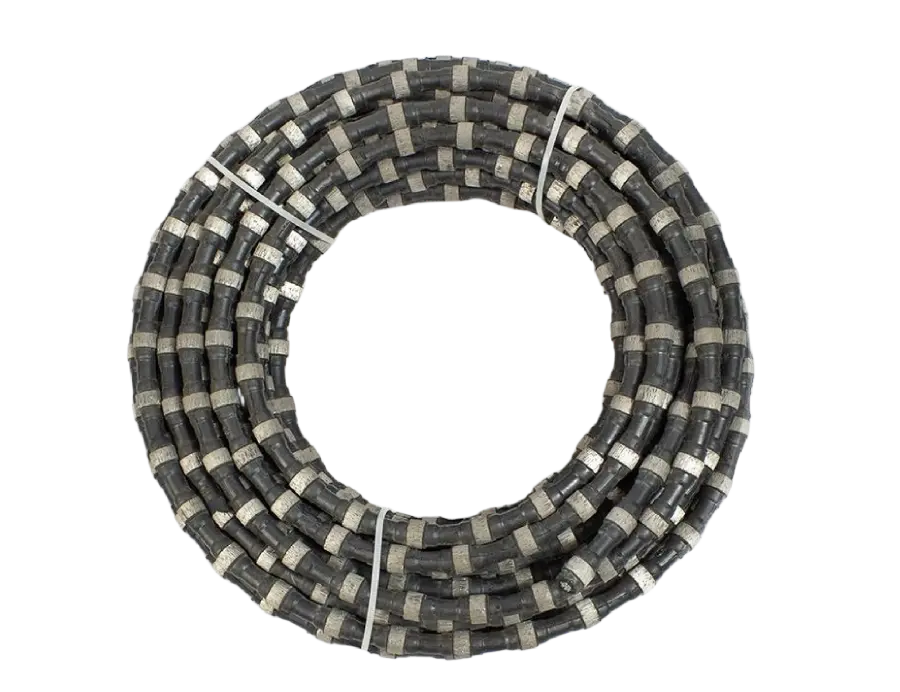
10.5-12 mmThree wire diameters — 10.5, 11.5 and 12 mm — for different granite hardness classes and KSSJ quarry machine setups.
40 beads/mA bead density of 40 beads per meter keeps the cutting edge supported along the kerf for steady granite cutting.
Rubber-CoatedRubber bead fixing resists high temperatures and harsh quarry conditions while damping vibration and noise.
Applicable Materials
Granite, gneiss, diabase, basalt and similar hard dimension stone used for quarry block extraction
Certifications & Credentials
CE Certified · ISO 9001:2015 · Industry Standard Drafting Participant · 120+ Countries & Regions Served
Diamond Wire Saw for Granite Applications & Materials
This rubber-coated quarry wire is built for the extraction stage of hard-stone quarries, where the wire runs for hours on a KSSJ quarry wire saw machine and the coating must survive friction heat, slurry and bench debris.
Granite Quarry Block Extraction
Run the rubber-coated wire on a KSSJ quarry wire saw machine to separate commercial granite blocks from the bench. The 10.5 / 11.5 / 12 mm diameter program covers different granite hardness classes, and the rubber fixing survives the friction heat of long quarry cuts.
High-Temperature & Harsh Bench Conditions
Quarry benches with abrasive stone, slurry and debris punish softer coatings. The high-temperature-resistant rubber compound keeps beads fixed and spacing stable where plastic-coated wires soften, lose beads and wander off the cut line.
Low-Noise Cutting Near Restricted Areas
The rubber carrier damps vibration along the wire, so cutting runs with low vibration, low noise and no dry dust at the face. Quarries operating near residential zones or under strict site-noise rules can keep production hours that louder methods would lose.
Remote-Controlled Cuts on Unstable Faces
Because the cut is controlled from a distance, the operator works away from high benches, fractured faces and undercut sections. Distance control is a practical safety margin on extraction lines where the face can move as the block releases.
Wire + Machine Matched Quarry Programs
DINOSAW supplies this wire as the quarry-duty member of the wire family, matched to KSSJ quarry wire saw machines. Wire diameter, loop length and machine setup are planned together so the quarry receives a working extraction combination rather than a wire alone.
Real Wire Sawing Performance & Key Metrics
This DINOSAW diamond wire saw for granite is the quarry-duty rubber-coated member of the wire family: 10.5 / 11.5 / 12 mm diameters with a 6 mm bead width and 40 beads per meter, built for granite block extraction on KSSJ quarry wire saw machines where heat, vibration and operator safety decide daily output.
10.5 / 11.5 / 12 mm
Diameter Program
Three standard diameters let the quarry match wire section to granite hardness and the KSSJ machine's flywheel and power class, instead of forcing one wire across every bench.
40 beads/m
Bead Density
At 40 beads per meter, cutting forces distribute along a closely spaced bead line, which supports a steady kerf in hard granite and smooths the load on each individual bead.
6 mm
Bead Width
The 6 mm bead width defines a narrow, controlled kerf, reducing the volume of stone converted to slurry per meter of cut and keeping block yield high.
Rubber
Coating System
Rubber fixing holds the beads firmly while resisting the friction heat of quarry feed speeds — the failure mode that softer coatings cannot survive in granite duty.
Applicable materials: Granite, gneiss, diabase, basalt and similar hard dimension stone used for quarry block extraction.
Typical products: Granite quarry blocks for slab production, architectural stone, monuments, cladding and other downstream dimension-stone processing.
Actual cutting rate and bead life vary with stone hardness and abrasiveness, wire diameter, machine feed settings, water supply and operator practice.
Rubber-Coated Granite Wire Specifications
Choose the diameter first: 10.5 mm for smaller KSSJ machines and more homogeneous granite, 11.5 mm as the general quarry balance, and 12 mm for the hardest, most abrasive benches. All three diameters share the same structure — 6 mm bead width, 40 beads per meter and rubber fixing — so the coating system and bead spacing stay constant while the wire section scales with the cutting duty.
Specification
Option 1
Option 2
Option 3
Wire diameter (mm)
10.5
11.5
12
Bead width (mm)
6
6
6
Beads per meter
40
40
40
Bead fixing
Rubber
Rubber
Rubber
Typical application
Granite quarry block extraction
Granite quarry block extraction
Granite quarry block extraction
Core Technology & Tool Structure
Six engineering decisions behind the rubber-coated quarry wire design. The numbered points on the tool diagram correspond to the systems below.
Quarry Wire Cutting Workflow
1 · Prepare the bench: confirm granite type, block dimensions, cutting lines, water supply and KSSJ machine position. 2 · Mount & tension: thread the closed-loop rubber-coated wire around the flywheels and pulleys, then set and verify tension. 3 · Cut: start water, set feed speed for the stone and diameter, and run the cut from the remote station. 4 · Release & inspect: complete the separation cuts, release the block, then inspect the wire for bead wear before the next cycle.
01
Rubber Bead Fixation
Each bead is fixed in a rubber carrier rather than a plastic one. Rubber holds the bead position under the side loads of a twisting quarry cut and absorbs shock when the wire re-enters the kerf, which keeps bead spacing stable over long cutting cycles.
02
High-Temperature Resistant Compound
Granite quarry cutting generates sustained friction heat at the bead line. The rubber compound is selected for high temperature resistance, so the fixing stays elastic and retains the beads instead of softening and letting beads migrate.
03
6 mm Bead Width
The 6 mm bead width sets a narrow kerf. A narrower kerf means less stone converted to slurry per meter of cut and higher block yield per bench, which directly changes how much saleable block a quarry keeps from each extraction cycle.
04
40 Beads-per-Meter Spacing
At 40 beads per meter, the cutting load is shared across a dense bead line. Dense spacing smooths individual bead loading in hard granite, supports a consistent kerf surface, and helps the wire track straight through long vertical cuts.
05
Low-Vibration, Low-Noise Cutting
The rubber carrier dampens vibration between beads and along the drive train. The result is lower vibration at the machine, lower noise at the bench, and no dry dust at the cutting face — conditions that matter on quarries near residential areas or with strict site rules.
06
Remote-Controlled Cutting Safety
The wire saw cut can be controlled from a distance, so the operator stations away from the cutting face. On high benches, fractured faces and undercut sections, distance control removes the operator from the main line of fire of the extraction zone.
Rubber-Coated vs. Plastic-Coated Diamond Wire
A coating-level comparison for choosing between the granite quarry wire and the marble squaring and trimming wire.
Rubber-Coated vs. Plastic-Coated Diamond Wire
Plastic-Coated Marble Wire
VS
Rubber-Coated Granite Wire (This Product)
Plastic carrier for cooler, lower-load duty
Bead fixing
✓Rubber carrier selected for high temperature resistance
Adequate at marble trimming speeds and temperatures
Coating behavior in heat
✓Stays elastic at granite quarry bead-line temperatures
Marble block squaring and trimming
Primary duty
✓Granite block extraction in quarries
Marble and softer dimension stone
Stone match
✓Granite and similar hard, abrasive dimension stone
Small squaring and trimming wire saws
Machine pairing
✓KSSJ quarry wire saw machines
Suitable for workshop trimming environments
Vibration & noise
✓Low vibration, low noise, no dry dust at the quarry face
Squaring and trimming marble blocks to size
Best for
✓Quarry-duty granite block extraction in harsh, hot cutting conditions
Note: configurations vary by brand and model; actual performance depends on the specific machine, material and working conditions.
The Manufacturer Behind the DINOSAW Quarry Wire Program
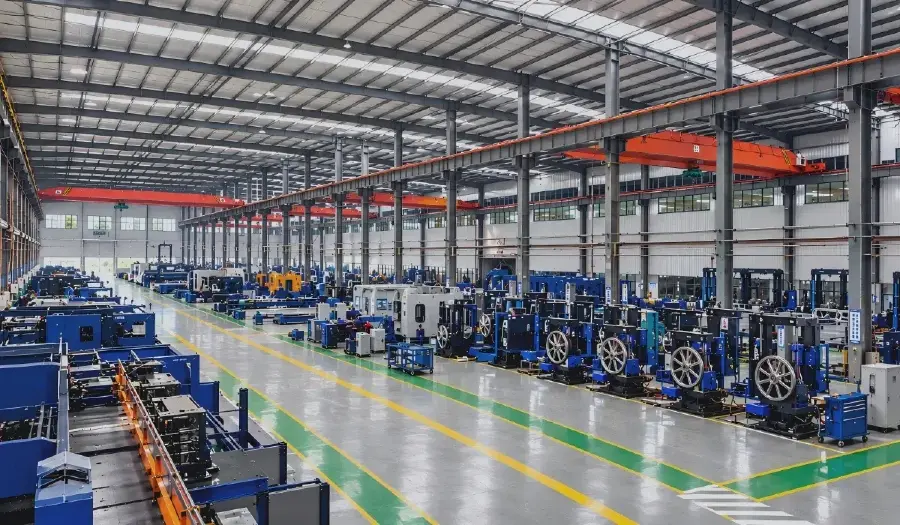
DINOSAW is a manufacturer of CNC stone processing machinery, specializing in diamond wire saw machines and CNC stone cutting equipment. With more than 20 years of R&D and manufacturing experience, DINOSAW contributes to industry standards including T/CMES 41001-2025 for CNC wire saw machines, holds 100+ technical patents, and supplies equipment and technical support to customers in 120+ countries and regions. Its manufacturing and management systems are certified to ISO 9001, ISO 14001 and ISO 45001, with CE-compliant machinery for international markets.
DINOSAW R&D & ManufacturingMechanical Design · CNC Control Development · Assembly · Testing · Commissioning · Global Delivery
Industry Standard Drafting
DINOSAW contributes to industry standards for stone machinery, including T/CMES 41001-2025 for CNC wire saw machines, as well as standards covering multi-wire saws, combined wire saw machines and five-axis bridge cutting equipment. This work reflects the company’s long-term involvement in machine design, manufacturing, testing and quality control.
20+Years of Stone Machinery R&D & Manufacturing Experience
100+Technical Patents — Covering machine structures, CNC control, cutting systems and stone processing technologies
120+Countries & Regions Served — Equipment, installation and technical support worldwide
CE Compliance & ISO Management Systems
CE: Stone cutting machinery assessed against Machinery Directive 2006/42/EC and relevant EN standards. ISO: Management systems certified to ISO 9001, ISO 14001 and ISO 45001.
Wire Supply Requirements & After-Sales Support
DINOSAW provides wire selection guidance, operator training, remote diagnosis and spare-parts coordination for every quarry wire order.
Wire Diameter10.5 / 11.5 / 12 mm
Diameter is selected with the granite hardness class and KSSJ machine model; the 6 mm bead width and 40 beads per meter structure stays constant across all three.
Machine MatchingKSSJ quarry wire saw machines
Loop length and connection configuration are confirmed against the machine model and flywheel arrangement, configured per destination site.
Water SupplyContinuous water at the cutting zone
Steady water delivery cools the bead line and flushes slurry from the kerf; quarry water setup is configured per destination site.
01 · Pre-Shipment & DeliveryMachine configuration, packaging and transport requirements confirmed before dispatch, with factory inspection and documents verified.
02 · Installation & CommissioningOn-site utilities and foundation check, machine positioning, commissioning and acceptance.
03 · Operator TrainingHands-on training covering routine CNC operation and daily checks of blades, spindles, cooling and lubrication.
04 · After-Sales SupportRemote technical assistance, maintenance support and spare parts coordination throughout the machine's service life.
Diamond Wire Saw for Granite Selection, Installation & Operation FAQ
How to choose between wire types and diameters, what the rubber coating does in quarry heat, and what to send before asking for a quotation.
Choose this wire when the job is granite block extraction in a quarry; choose another wire when the job is marble finishing, demolition or precision cutting outside the quarry program. This page covers the quarry-duty rubber-coated member of the DINOSAW wire family: diameters of 10.5, 11.5 and 12 mm, a 6 mm bead width and 40 beads per meter, built to run on KSSJ quarry wire saw machines. If you are squaring or trimming marble blocks, the plastic-coated marble wire is the correct product — its coating is matched to the lower cutting temperatures and softer abrasion of that duty. For sharp cutting of marble in workshop conditions, look at the electroplated or brazed wire range instead. For concrete demolition and reinforced-structure cutting, the RC wire is engineered for that impact-heavy duty. And if you need a configured wire outside this quarry program — for example small diameters for special shapes — the diamond wire family page covers the full range from 0.35 mm upward. Telling us the stone, the machine and the cut type is usually enough for us to point you to the right product before any quotation is prepared, which saves both sides a wrong-specification cycle.
Choose the diameter from the granite and the machine, because all three share the same structure — 6 mm bead width, 40 beads per meter and rubber fixing. The 10.5 mm wire suits smaller KSSJ quarry machines and more homogeneous, medium-hard granite where the machine's power and flywheel arrangement cannot load a heavier wire efficiently. The 11.5 mm wire is the general quarry balance: enough section for hard, abrasive granite on standard KSSJ setups without overloading smaller machines. The 12 mm wire is intended for the hardest and most abrasive benches, where a larger wire section carries the load that would wear a thinner wire prematurely. In practice, send us the granite type or a sample description, the KSSJ machine model, and the typical cutting depth; we confirm the diameter against the machine's power class and your production target. If your quarry mixes stone classes across benches, it is common to standardize on the 11.5 mm wire and reserve the 12 mm wire for the hardest sections, rather than stocking all three diameters from the first order.
The rubber compound is there to hold the beads in position under heat and shock — the two conditions that end a quarry wire's life early. During a granite cut, each bead generates friction heat at the cutting face, and the wire flexes and twists as it travels around flywheels and through a kerf that is never perfectly straight. A rubber carrier with high temperature resistance stays elastic at bead-line temperatures, so beads cannot migrate or spin, and it absorbs the shock when the wire re-enters the cut after passing a pulley. This is why the wire is specified for harsh working conditions: abrasive slurry, bench debris and long cutting cycles are exactly the environment where a softer plastic carrier would soften, lose bead spacing and start wandering off the line. The same rubber carrier also damps vibration along the wire, which is the mechanism behind the low-vibration, low-noise running and the absence of dry dust at the face. None of this changes the basic physics — bead life still varies with stone abrasiveness, water supply and feed discipline — but it removes the coating itself from the list of failure causes.
This wire is the matched cutting tool for DINOSAW KSSJ quarry wire saw machines, supplied as a closed loop ready to mount. Installation follows the KSSJ manual: thread the loop around the main flywheel and the guide pulleys along the cutting line, then set tension to the machine's specified range before the first cut. Correct tension matters more with a rubber-coated wire than operators expect — too loose and the wire wanders and slaps the pulleys, too tight and the carrier is overloaded before the stone ever loads the beads. Once mounted, the cut itself is controlled from the machine's remote station, so the operator works at a distance from the face. Before production, confirm three things: that the loop length matches your KSSJ model and pulley arrangement, that water delivery reaches the bead line continuously, and that the first cut is run at a conservative feed speed so wear behavior can be checked on the actual granite. DINOSAW can coordinate wire specification, loop length and machine setup as one package so the quarry receives a working extraction combination rather than a wire that still needs engineering on site.
Send six items first, and the quotation becomes a configuration instead of a guess. One: the stone — granite type, origin or a hardness description, because stone abrasiveness is the main variable behind both diameter choice and bead life. Two: the machine — your KSSJ quarry wire saw model, or the machine you intend to pair the wire with, since loop length and diameter must match the flywheel and power class. Three: the cutting program — typical block dimensions, average cutting depth and meters of cut per week, which converts into wire consumption and order volume. Four: working conditions — water supply at the face, bench temperatures and any debris or slurry issues, because these confirm the rubber specification is the right coating class. Five: destination country, so packing, documentation and delivery terms are quoted correctly. Six: whether you need a one-off trial order or a recurring supply program, since recurring quarry programs are quoted differently from single loops. With these six items, DINOSAW can confirm diameter, loop configuration and delivery schedule in one reply — and if the application turns out to fit another wire in the family better, we say so before you order.
Contact Dinosaw
Discuss Diamond Wire Saw for Granite Pricing, Configuration & Application
Are you looking for the perfect cutting machines or processing solutions for hard and brittle materials?
Facing challenges in stone quarrying, countertop cutting, concrete and underwater pipeline cutting, stainless steel rust removal and grinding, luxury thin slab cutting, agate and gemstone cutting, graphite cutting, or even building demolition?
Leave your inquiry, and you can expect a reply within 12 hours with tailored solutions!













 English
 中文