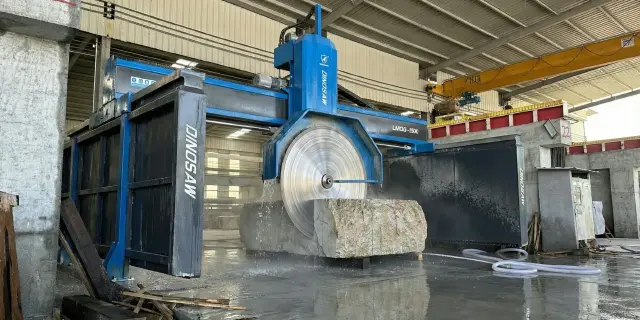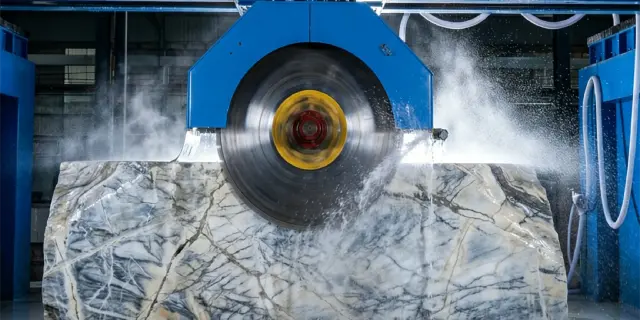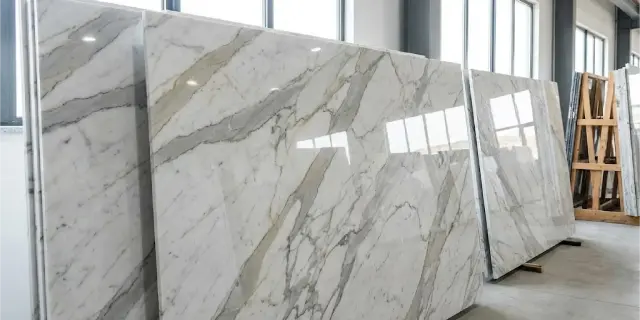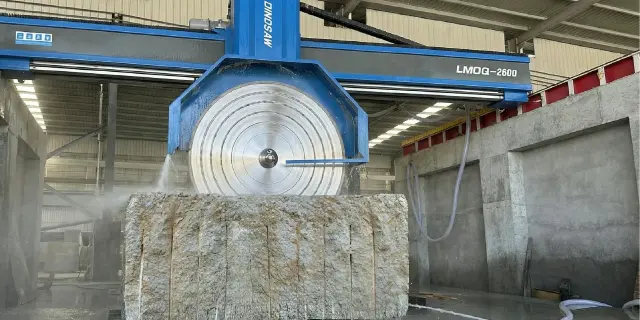
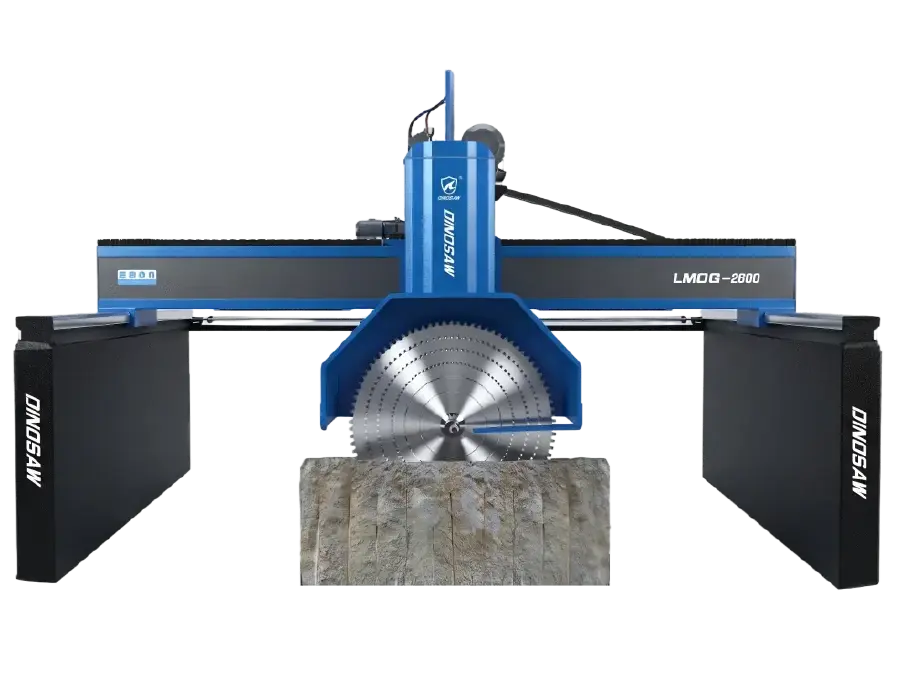
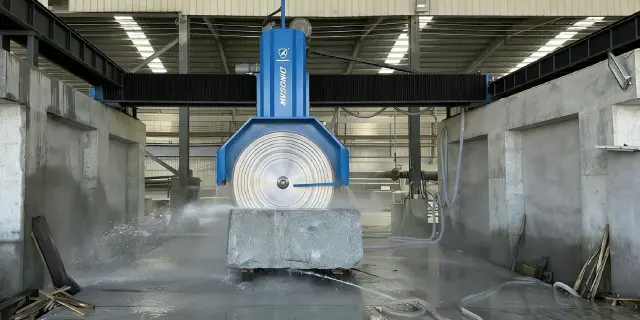
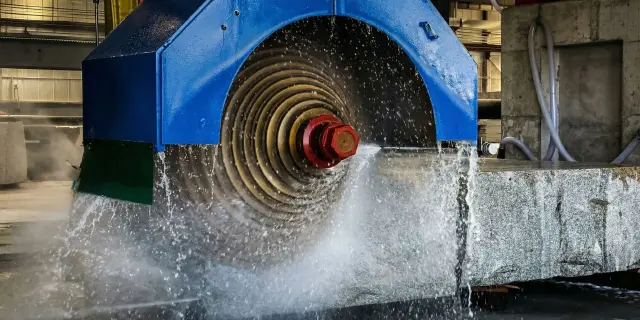
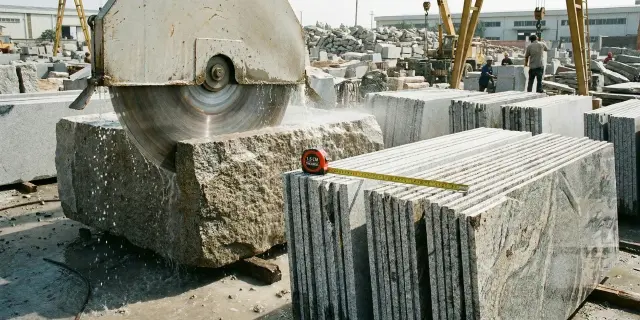
Stone Block Cutting Machine for Granite, Marble, and Limestone Blocks

LMDQ-2200/2500/2800/3000
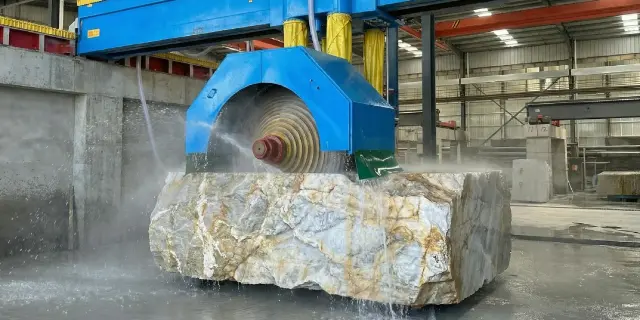
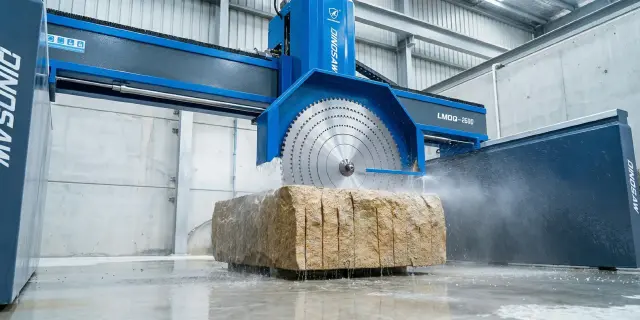
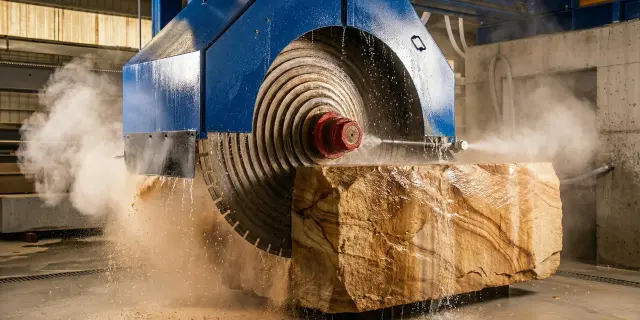
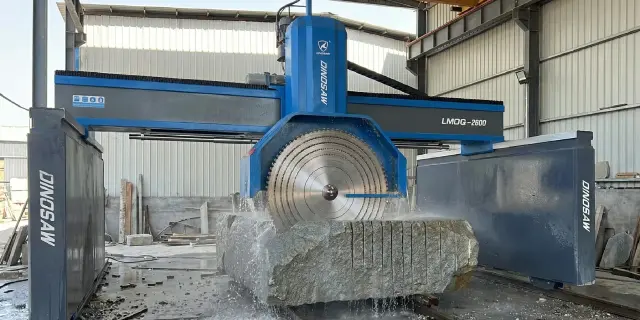
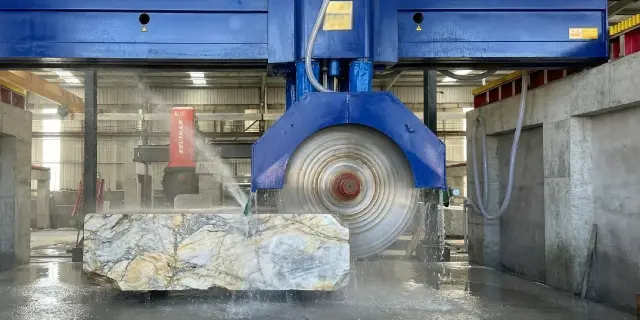
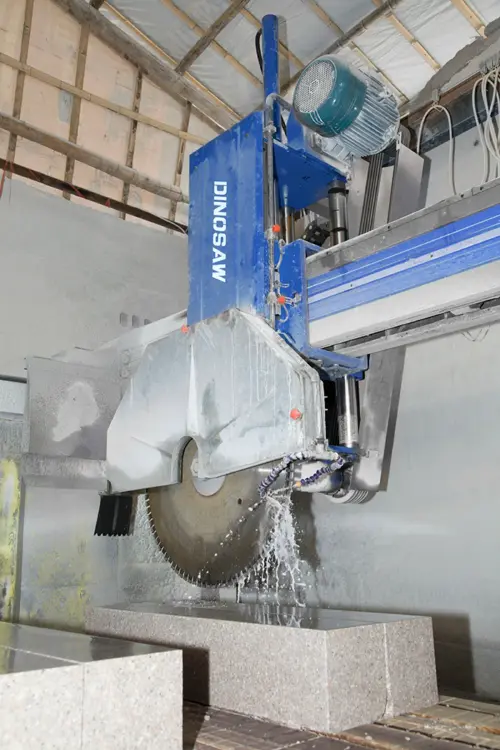
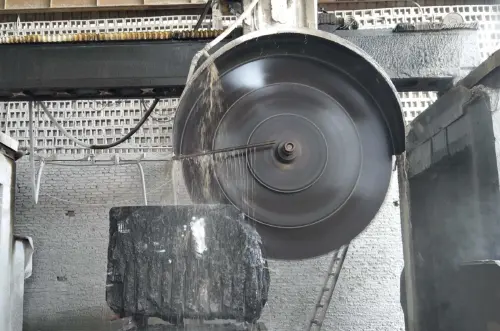
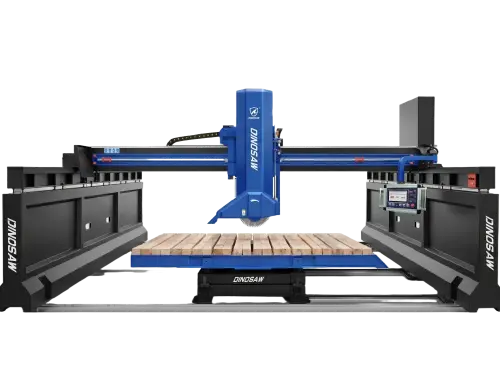
Dinosaw Machine's LMDQ stone block cutting machine is designed for straight cutting of granite, marble and limestone blocks in factory production. Depending on the selected single- or multi-blade configuration, it supports flexible block sizing or repeated block-to-slab cutting. The bridge structure is intended for routine block-processing work where stability and sustained output matter. Choose the LMDQ-2200, LMDQ-2500, LMDQ-2800 or LMDQ-3000 around the required cutting envelope, material, blade combination and slab program. Match the configuration to the workshop layout, loading arrangement, utilities and output target.
120 m²/hHigh-volume block-to-slab output
Up to 9 BladesMulti-blade combinations configured around slab thickness
±0.2 mmHydraulic cutting consistency across the full blade set

Applicable Materials

Granite, marble, limestone, sandstone and quartzite

Certifications & Credentials

CE Certified · ISO 9001:2015 · Industry Standard Drafting Participant · 120+ Countries & Regions Served

Stone Block Cutting Machine Applications

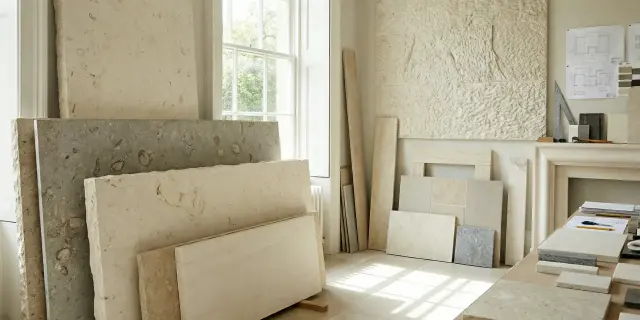
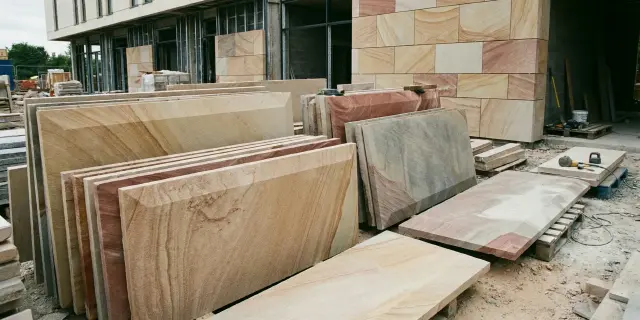
High-volume block cutting into slabs and dimensioned stone for tombstone, kerbstone and slab production lines.

Real Cutting Performance & Key Metrics

The LMDQ series turns raw blocks into finished slabs at production scale: up to nine blades per cut, 120 m²/h output, ±0.2 mm hydraulic precision and permanent-magnet drive that cuts energy use by 20%.

120 m²/h

Multi-Blade Output

A 55 kW main motor, heavy-duty spindle and multi-blade system achieve 120 m²/h cutting with high efficiency.

±0.2 mm

Cutting Precision

Hydraulic lift holds ±0.2 mm; gear rack feed and PLC control keep slab thickness consistent across the full block.

Up to 9 Blades

Blade Combinations

Blade sets (e.g. Φ2200+Φ2000+Φ1800+…) slice multiple slabs per pass — combination selected per slab thickness program.

20% Less Energy

Permanent Magnet Drive

Permanent magnet motor technology cuts energy consumption by about 20% at equivalent production output.

Applicable materials: Granite, marble, limestone, sandstone and quartzite.

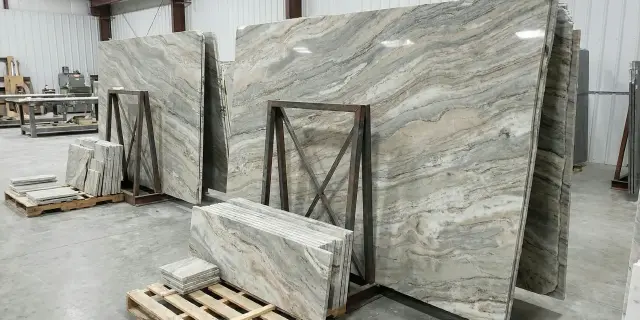
Typical products: Standard slabs from raw blocks for tile, countertop and construction-material production.

Actual output varies with stone hardness, blade combination and on-site conditions.

Stone Block Cutting Machine Specifications

Four LMDQ sizes (2200–3000 mm blade class) scale motor power from 45 to 75 kW and blade counts up to nine per cut. Recommended blade combinations are matched to slab thickness programs at configuration; the cast bridge structure and large guide columns carry continuous multi-blade duty.

ModelUnitLMDQ-2200LMDQ-2500LMDQ-2800LMDQ-3000
Max. diameter of blademmΦ2200Φ2500Φ2800Φ3000
Max. No. of bladespc991(5)1(5)
Recommended Blade CombinationmmΦ2200 Φ2000
Φ1800 Φ1600
Φ1400 Φ1200
Φ1000 Φ800 Φ600
Φ2500 Φ2200
Φ2000 Φ1800
Φ1600 Φ1400
Φ1200 Φ1000 Φ800
Φ2800
(Φ2800 Φ2500
Φ2000 Φ1500
Φ1000)
Φ3000
(Φ3000 Φ2500
Φ2000 Φ1500
Φ1000)
Main motor powerKW4545/555575
Max. Cutting size (L x W x H)mm4000 x 2200 x 9503700 x 2200 x 11003500 x 2200 x 13003500 x 2200 x 1350
Overall dimensions (L x W x H)mm7500 x 4000 x 70007500 x 4000 x 70007500 x 4000 x 70008000 x 4000 x 7000
Water consumptionm³/h15151515
Approximate Weightt11111213

Core Technology & Machine Structure

Six core systems behind 120 m²/h multi-blade cutting. The numbered points on the machine diagram correspond to the systems below.

Dinosaw machine Heavy-Duty Stone Block Cutting Machine with Multi-Blade Bridge Cutter

Block-to-Slab Production Workflow

A production run follows four steps: load the block and select the blade combination per the slab program, set thickness parameters on the PLC, run the multi-blade cut, then unload the slab stack from either side — repeat cycles run continuously with overload protection active.

01

Multi-Blade Cutting System

A multi-blade set creates several slab faces in the same cutting cycle — a nine-blade setup can separate up to eight slab sections per pass depending on the configured spacing. Multi-blade cutting is the difference between workshop output and factory output on the same block.

02

Heavy-Duty Spindle

The 55 kW heavy-duty spindle (75 kW on the largest class) delivers torque for full-depth multi-blade cuts in hard granite and quartzite.

03

Hydraulic Lift Precision

Hydraulic lifting with gear-rack feed and PLC control holds ±0.2 mm across the cut, so every slab in the stack meets the same thickness specification.

04

Cast Bridge & Guide Columns

The cast bridge, reinforced beams and large guide columns carry continuous multi-blade load without geometry drift — the structural basis for the documented longer service life.

05

Permanent Magnet Drive

Permanent-magnet drive reduces energy consumption by about 20% at equivalent production output, which matters on machines running long multi-blade shifts.

06

Continuous Production Protection

Motor overload protection stops the cut before damage on hard seams, and front-and-rear loading lets slabs roll out on either side — together they keep continuous production lines running with fewer stoppages.

Multi-Blade vs. Single-Blade Block Cutting

An output-focused comparison for block-to-slab factories.

Multi-Blade vs. Single-Blade Block Cutting
Single-Blade CuttingVSLMDQ Multi-Blade
Flexible individual cutsProduction style✓ Repeated standardized slab production
One cutting plane per passSlabs per cycle✓ Multiple slab planes simultaneously
Fast and flexibleThickness change✓ Blade set reconfiguration
Flexible, job-pacedOutput✓ Up to 120 m²/h
Sequential passesConsistency✓ ±0.2 mm across the whole stack
Mixed jobs and trimmingBest for✓ High-volume standard slab programs

Note: configurations vary by brand and model; actual performance depends on the specific machine, material and working conditions.

The Manufacturer Behind the LMDQ Series

DINOSAW is a manufacturer of CNC stone processing machinery, specializing in diamond wire saw machines and CNC stone cutting equipment. With more than 20 years of R&D and manufacturing experience, DINOSAW contributes to industry standards including T/CMES 41001-2025 for CNC wire saw machines, holds 100+ technical patents, and supplies equipment and technical support to customers in 120+ countries and regions. Its manufacturing and management systems are certified to ISO 9001, ISO 14001 and ISO 45001, with CE-compliant machinery for international markets.

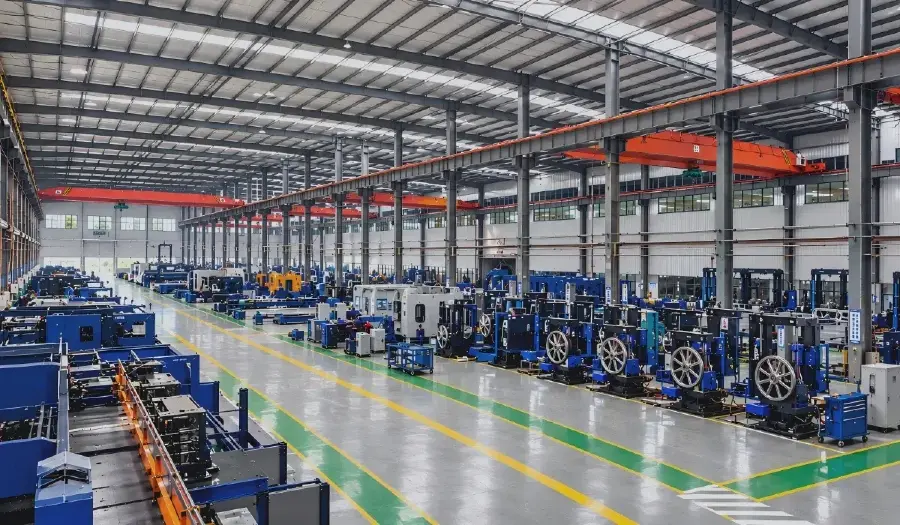
DINOSAW CNC stone machinery manufacturing workshop
DINOSAW R&D & ManufacturingMechanical Design · CNC Control Development · Assembly · Testing · Commissioning · Global Delivery
Industry Standard Drafting

DINOSAW contributes to industry standards for stone machinery, including T/CMES 41001-2025 for CNC wire saw machines, as well as standards covering multi-wire saws, combined wire saw machines and five-axis bridge cutting equipment. This work reflects the company’s long-term involvement in machine design, manufacturing, testing and quality control.

20+Years of Stone Machinery R&D & Manufacturing Experience
100+Technical Patents — Covering machine structures, CNC control, cutting systems and stone processing technologies
120+Countries & Regions Served — Equipment, installation and technical support worldwide

CE Compliance & ISO Management Systems

CE: Stone cutting machinery assessed against Machinery Directive 2006/42/EC and relevant EN standards.
ISO: Management systems certified to ISO 9001, ISO 14001 and ISO 45001.

Installation Requirements & After-Sales Support

DINOSAW provides installation guidance, operator training, remote diagnosis and spare-parts coordination for every machine.

Power Supply45–75 kW by model, configured per destination

Permanent magnet drive; voltage confirmed against local standards before shipment.

Foundation & CranePer model drawings + overhead crane

Foundation strictly per DINOSAW drawings; crane for blocks and machine bodies.

Water SupplyCutting water, recycling recommended

Multi-blade slurry volume requires sized drainage; recycling recommended.

01 · Pre-Shipment & DeliveryMachine configuration, packaging and transport requirements confirmed before dispatch, with factory inspection and documents verified.
02 · Installation & CommissioningOn-site utilities and foundation check, machine positioning, commissioning and acceptance.
03 · Operator TrainingHands-on training covering routine CNC operation and daily checks of blades, spindles, cooling and lubrication.
04 · After-Sales SupportRemote technical assistance, maintenance support and spare parts coordination throughout the machine's service life.

LMDQ Block Cutting Machine Selection, Installation & Operation FAQ

Common Questions About Heavy-Duty Stone Block Cutting Machines

This machine cuts large natural stone blocks by straight circular-blade sawing. Single-blade configurations can size or divide blocks; the multi-blade configuration can produce repeated slab sections for the selected production program.

Typical materials you cut on this machine

  • Granite blocks

  • Marble blocks

  • Bluestone and limestone blocks

  • Other large natural stone blocks

Match the setup to the next process. Block-sizing work may prepare material for a frame saw or another cutting stage, while a multi-blade slab program feeds the following sizing, calibration or polishing operation. The selected blade combination determines the cutting role.

What to confirm before deciding
Confirm your block material types and whether you handle large, heavy blocks rather than small finished products.

This is a bridge-type stone block cutting machine.

What that means in practice

  • A full bridge spans over the stone block

  • Cutting force is supported on both sides

  • The block stays fixed while the machine cuts

Compared with single-column or compact block cutters, a bridge-type structure is built for larger blocks, heavier loads, and long continuous cutting.

What to confirm before deciding
Confirm whether your current block cutter struggles with block size, stability, or long cutting cycles.

The difference comes mainly from structure and capacity, not small feature details.

Compared with other common block cutters

  • Versus single-column block cutters: more stable on large blocks

  • Versus compact or trolley-type machines: much larger cutting range

  • Versus horizontal blade block cutters: better suited for tall and wide blocks

Bridge-type machines are chosen when block size and long-term stability matter more than compact footprint.

What to confirm before deciding
Look at the type of block cutter you are currently using and where its limits appear in daily production.

A bridge-type structure allows much larger cutting dimensions than compact block cutting machines.

What this means for your production

  • You can cut wider and taller stone blocks

  • Heavy blocks can be processed without frequent repositioning

  • Long straight cuts remain stable across the full block width

The open bridge span is the key reason this type of machine is used for large-format stone blocks.

What to confirm before deciding
Check your maximum block width, height, and weight against the machine’s cutting dimensions.

Check length, width and height together against the selected model. The catalogue lists maximum cutting sizes of 4000 × 2200 × 950 mm for LMDQ-2200, 3700 × 2200 × 1100 mm for LMDQ-2500, 3500 × 2200 × 1300 mm for LMDQ-2800 and 3500 × 2200 × 1350 mm for LMDQ-3000.

Illustrative size check: A block measuring 3600 × 2000 × 1200 mm exceeds the height of the first two models and the length of the last two. None of the four listed envelopes covers that complete block, even though the larger blade classes meet its height. Evaluate block preparation or a confirmed extended configuration before selecting a model.

Use the required cutting orientation, actual support and loading arrangement with this check. Confirm the permitted block weight and handling capacity separately; the machine's approximate weight in the table is not its workpiece load rating.

Factories choose bridge-type block cutters because they are more stable, handle larger blocks, and support higher-throughput block cutting.

What you gain in real production

  • Fewer interruptions during long cuts

  • Less block handling and repositioning

  • A more reliable front-end cutting stage for slab production

This makes bridge-type machines suitable when block cutting is a core production step, not an occasional task.

What to confirm before deciding
Confirm whether your current block cutting stage limits overall factory output.

The LMDQ block cutter and a frame gangsaw can both be evaluated for block-to-slab production. The useful comparison is the cutting system and the slab program each machine supports.

How the systems differ

  • LMDQ circular-blade block cutter: Select the single- or multi-blade setup, blade diameters and cutting envelope around the block size and repeated slab dimensions.
  • Frame gangsaw: Uses frame-mounted blades for slab sawing. Compare the material, slab dimensions, kerf, accepted recovery and downstream finishing required by the proposed setup.

How they fit your production line

An LMDQ configured for block sizing may prepare material for a later cutting stage. When configured for multi-blade slab cutting, it performs the slab-cutting task itself. A frame saw can therefore be an alternative for a slab program or part of a different line arrangement; the sequence depends on the job.

What to confirm before deciding

Compare the same stone, block dimensions, slab thickness and finished dimensions. Include setup, loading, unloading, tool consumption, trimming and subsequent finishing when assessing output and recovery.

Yes. This bridge-type block cutter can be configured with a single blade or multiple blades, depending on your production needs.

How different blade setups are used

  • Single-blade setup

    • Used for flexible block sizing

    • Suitable when block dimensions vary

    • Easier setup and adjustment

  • Multi-blade setup

    • Used for higher-throughput block cutting

    • Allows multiple parallel cuts in one pass

    • Suitable for standardized block sizes and stable production runs

Because of the bridge-type structure, the machine can support heavier blade loads and maintain stability even with multiple blades installed.

What to confirm before deciding
Confirm whether your blocks are standardized enough to benefit from multi-blade cutting, or whether you need the flexibility of single-blade operation.

This machine is best suited for factories where block cutting is a continuous, high-load operation.

You are a good fit if

  • You process large natural stone blocks daily

  • Block cutting is a bottleneck in your production line

  • You need stable cutting on heavy blocks

It is commonly used in medium-to-large stone factories that handle significant block volumes.

What to confirm before deciding
Assess whether block cutting is a core operation or an occasional task in your factory.

A bridge-type block cutter requires proper planning for space, power, and material handling.

Key points to plan for

  • Sufficient floor space for large blocks

  • Stable power supply for heavy-duty cutting

  • Lifting equipment for block loading

Daily operation focuses on straight cutting and monitoring the cutting process rather than complex setup.

What to confirm before deciding
Confirm available space, power capacity, and block handling equipment in your workshop.

This machine may not be the right choice if your block cutting needs are limited or highly specialized.

It may not fit your needs if

  • You only cut small blocks occasionally

  • Your required slab dimensions, material or recovery target are better served by a different sawing route.

  • An existing or more compact machine already meets the block size, cutting program and production volume you need.

In these cases, other block cutting machines may be more cost-effective.

What to confirm before deciding
Be clear about your actual block cutting workload and where this machine fits in your production flow.

The machine mounts a set of blades at fixed spacing on the spindle; each pass cuts one slab per blade gap, so a nine-blade set slices up to eight slabs per pass. The combination is selected per slab thickness program: for 20 mm tiles the set uses closely spaced smaller blades (e.g. Φ2200+Φ2000+Φ1800+… down to Φ600), while thicker programs use fewer, larger blades. DINOSAW recommends the blade combination from your target slab thickness and block dimensions at configuration.

Check the model-specific blade count as well as diameter. LMDQ-2200 and LMDQ-2500 are listed with up to 9 blades, while LMDQ-2800 and LMDQ-3000 show 1(5) in the catalogue. Specify the actual blade combination in the quotation rather than assuming the largest diameter uses the most blades. Match the combination's working depths and spacing to the slab program.

No — blade count and slab count are related but not identical. A nine-blade set creates eight spaces between blades, so a standard nine-blade configuration produces up to eight slab sections per pass. The actual arrangement depends on the slab thickness program and the blade combination, which DINOSAW configures with you before delivery.

Choose multi-blade when your slab thickness is standardized and volume is the target: the LMDQ slices several slabs per pass at up to 120 m²/h with ±0.2 mm consistency across the stack. Choose the QSDP single-blade cutter when block sizes vary, products change between slabs, kerbs and tombstone blanks, or the work is trimming-oriented. Many factories run both — single-blade for flexible jobs, multi-blade for the volume program.

A multi-blade LMDQ can be evaluated for repeated straight cutting of marble blocks into the slab dimensions supported by its configuration. Start with the material condition, usable block size, target thickness and required finished format.

When comparing machines for marble block cutting, measure kerf and trimming loss, accepted slab recovery, complete-cycle output, tool consumption and subsequent calibration or polishing on the same job. Include the proposed frame-saw or multi-wire route where relevant. The best choice depends on that production comparison and your order mix.

For the differences between frame and wire sawing, see the marble gangsaw and wire-saw comparison.

Contact Dinosaw

Discuss LMDQ Pricing, Configuration & Application

Are you looking for the perfect cutting machines or processing solutions for hard and brittle materials?

Facing challenges in stone quarrying, countertop cutting, concrete and underwater pipeline cutting, stainless steel rust removal and grinding, luxury thin slab cutting, agate and gemstone cutting, graphite cutting, or even building demolition?

Leave your inquiry, and you can expect a reply within 12 hours with tailored solutions!

Prefer email?

You can also reach us at

gma@dinosawmachine.com
Stone Block Cutting Machine for Granite, Marble, and Limestone Blocks

What materials will you be working with? *

Your Name / Company Name? *

Phone Number / Email Address? *

+86

What specific requirements do you have?

LMDQ Guides & Related Machines

Selection guides and related equipment for multi-blade block-to-slab production.

Get A Easy Solution

Chat Online
Ms.Lizzy

Hi, this is Lizzy from Dinosaw ( Not a Robot ).  Which Machine ( model ) do you want? Please WhatsApp us now

WhatsApp Chat Now
Contact Us

Hello 👋 How can we help?