Diamond Profiling Wheel for Stone Edge Profile Forming

Sintered 150/200 - Vacuum Brazed 250/300/350/400 - Electroplated Custom
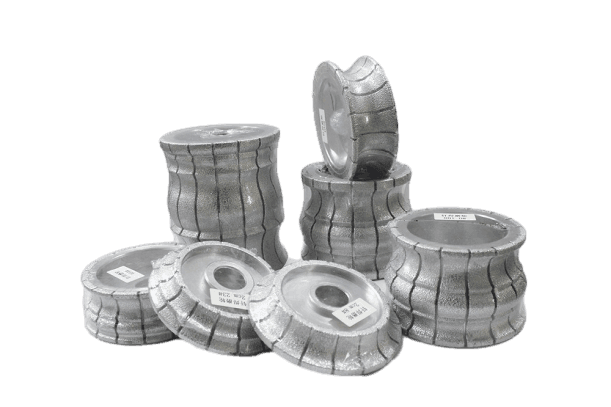
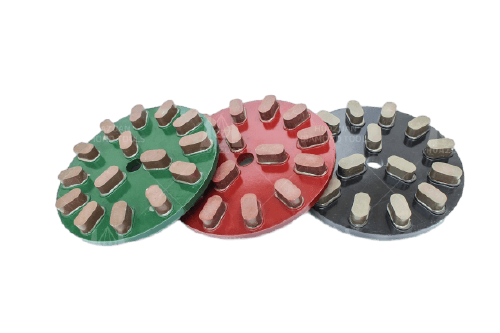
The DINOSAW diamond profiling wheel is a line-mounted edge forming tool for edge-polishing machines: it cuts the profile into marble, limestone, granite, sandstone, basalt, tiles, ceramic and other materials before the polishing wheels finish the edge. The wheel program covers the full A–PE profile vocabulary in three constructions — sintered, vacuum brazed and electroplated. Sintered wheels are offered at 150/200 mm diameter with 22.23/25.4 mm inner holes and 30/35/40 mm thickness; vacuum brazed wheels at 250/300/350/400 mm diameter and 50/60 mm thickness; electroplated wheels are produced at custom diameters. Products hold uniform thickness and accurate shapes for long service life, with high grinding efficiency and small dimensional differences in forming. Customized service caters to different processing objects, equipment and project requirements, so the same profile code can be supplied in different constructions and sizes matched to the stone and the line.
A–PE · 25 ProfilesThe full standard edge profile vocabulary from A through PE, covering bullnose, bevel, ogee and stair-tread edge families.
150–400 mmCatalog diameters from 150/200 mm sintered wheels to 250–400 mm vacuum brazed wheels, plus custom electroplated sizes.
3 ConstructionsSintered, vacuum brazed and electroplated bonds matched to granite, marble, limestone, sandstone, basalt, tiles and ceramic.

Applicable Materials

Marble, limestone, granite, sandstone, basalt, tiles, ceramic and other stone or hard material

Certifications & Credentials

CE Certified · ISO 9001:2015 · Industry Standard Drafting Participant · 120+ Countries & Regions Served

Diamond Profiling Wheel Applications & Materials

Profiling wheels sit at the front of the edge-polishing line, where the edge is formed to its final cross-section before polishing wheels bring it to gloss on slabs, tiles and cut-to-size pieces.

Real Profiling Performance & Key Metrics

The DINOSAW diamond profiling wheel is the forming station of the edge-polishing line: a line-mounted wheel that cuts the A–PE edge profile into the stone before polishing wheels finish it. Three bond constructions and a customized service let fabricators hold one profile across different stones, thicknesses and production volumes.

A–PE

Full Profile Vocabulary

Twenty-five standard profile codes from A through PE let a fabricator quote any common architectural edge — bullnose, bevel, ogee, stair nosing — from a catalog number instead of a custom tool drawing.

150–400 mm

Catalog Diameter Range

Sintered wheels at 150/200 mm cover compact lines and smaller stone, while vacuum brazed wheels at 250/300/350/400 mm serve high-volume slab edge programs on larger machines.

3 Bonds

Sintered / Brazed / Electroplated

Sintered metal bond for long runs on hard stone, vacuum brazed for aggressive forming on softer stone, electroplated for tiles, ceramic and custom diameters — one profile code, three working characters.

Custom Service

Per-Project Customization

DINOSAW customizes wheels around the processing object, equipment and project requirements, so non-standard diameters and profile combinations are supplied against the customer's drawing.

Applicable materials: Marble, limestone, granite, sandstone, basalt, tiles, ceramic and other stone or hard material.

Typical products: Profiled slab edges for countertops and vanities, tile and ceramic edge programs, skirting, stair treads and cut-to-size pieces entering an edge-polishing line.

Actual grinding efficiency, wheel life and edge dimensional accuracy vary with stone hardness and abrasiveness, bond selection, spindle speed, water supply and feed rate.

Profiling Wheel Constructions & Specifications

Choose the construction first, then the size. Sintered wheels (150/200 mm diameter, 22.23/25.4 mm inner hole, 30/35/40 mm thickness) suit production-line duty on hard stone. Vacuum brazed wheels (250/300/350/400 mm diameter, 50/60 mm thickness) cover larger line formats on softer stone. Electroplated wheels are made at custom diameters for tiles, ceramic and special requirements. All three constructions are available across the full A–PE profile range.

SpecificationSinteredVacuum BrazedElectroplated
Diameter (mm)150 / 200250 / 300 / 350 / 400Custom per order
Inner hole (mm)22.23 / 25.4——
Thickness (mm)30 / 35 / 4050 / 60Per profile depth
Profile rangeA–PE (all codes)A–PE (all codes)A–PE (all codes)

Core Technology & Tool Structure

Six engineering decisions behind the DINOSAW profiling wheel design. The numbered points on the tool diagram correspond to the systems below.

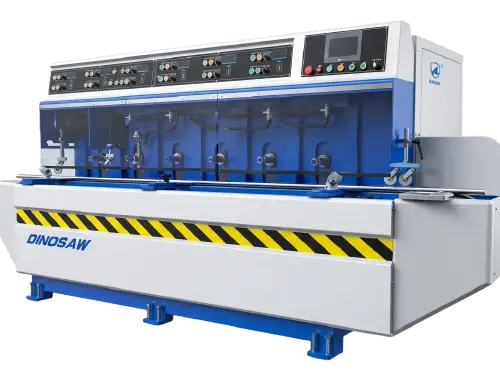
Dinosaw machine Diamond  profiling  wheel

Edge Profile Forming Workflow

1 · Select & confirm: choose the profile code from the A–PE range, confirm stone, thickness and target edge, and match the construction to the material. 2 · Mount & set: install the wheel on the line spindle, set forming depth and confirm water delivery to the wheel zone. 3 · Run the forming pass: the line feeds pieces past the wheel, which cuts the profile before the polishing stations. 4 · Verify & finish: check the first pieces against the drawing, then release the run to the polishing wheels for gloss finishing.

01

Sintered Metal Bond Rim

The sintered construction distributes diamond through a metal bond rim, so the bond wears in step with the abrasive and the A–PE profile stays sharp through long production runs on granite, basalt and other hard, abrasive stone.

02

Vacuum Brazed Diamond Layer

Vacuum brazing fixes a single exposed diamond layer directly to the wheel body, creating an open, aggressive cutting surface. On marble, limestone and sandstone it clears debris fast and limits the heat that can mark a soft stone edge.

03

Electroplated Nickel Bond

Electroplated wheels hold diamond in a nickel layer at the highest protrusion of the three constructions, cutting cool and free. This suits tiles, ceramic and engineered materials, and makes custom diameters economical in small quantities.

04

Profile-Accurate Rim Geometry

Each wheel is produced to a fixed master geometry per profile code, which is the mechanism behind the uniform thickness and accurate shapes customers see across a production batch — small dimensional differences from piece to piece.

05

Uniform Thickness Control

Rim thickness is held uniform around the full wheel circumference, so the forming depth does not drift as the wheel rotates. The polishing stage downstream then works against a consistent edge instead of compensating for a wavy profile.

06

Custom Wheel Engineering

The customized service caters to different processing objects, equipment and project requirements: non-standard diameters, special profile combinations and bond adjustments are engineered against the customer's drawing and machine data.

Diamond Profiling Wheel vs. Router Bits

Choose by production format: line-mounted forming wheels for volume edge programs, router bits for CNC and handheld detail work.

Diamond Profiling Wheel vs. Router Bits
CNC / Handheld Router BitsVSDiamond Profiling Wheel
Shank-mounted bit for CNC routers and handheld machinesTool format✓ Line-mounted forming wheel for edge-polishing machines
Limited to each purchased bit geometryEdge profile range✓ Full A–PE vocabulary: 25 standard profile codes
One-off shapes, detail work, repairsProduction role✓ Continuous edge forming before polishing wheels finish the edge
Small diameters set by shank and cutter bodyTool diameter✓ 150–400 mm catalog diameters across constructions
Program and toolpath change per shapeChangeover✓ Wheel swap per profile code on the same spindle
Dependent on operator and program setupEdge consistency✓ Uniform thickness and small forming dimensional differences
CNC detail profiling, curved one-off geometry, on-site repairBest for✓ Line-volume production of standard edge profiles on slabs, tiles and countertops

Note: configurations vary by brand and model; actual performance depends on the specific machine, material and working conditions.

The Manufacturer Behind the DINOSAW Profiling Wheel Line

DINOSAW is a manufacturer of CNC stone processing machinery, specializing in diamond wire saw machines and CNC stone cutting equipment. With more than 20 years of R&D and manufacturing experience, DINOSAW contributes to industry standards including T/CMES 41001-2025 for CNC wire saw machines, holds 100+ technical patents, and supplies equipment and technical support to customers in 120+ countries and regions. Its manufacturing and management systems are certified to ISO 9001, ISO 14001 and ISO 45001, with CE-compliant machinery for international markets.

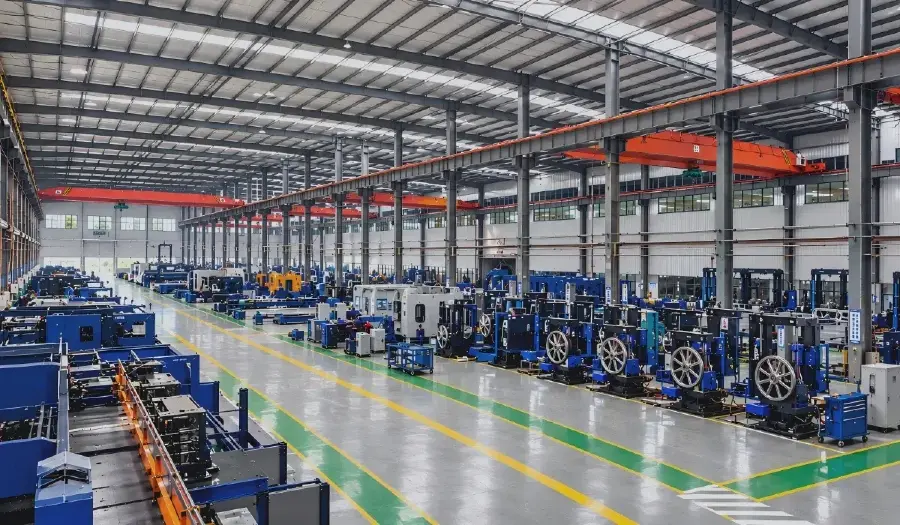
DINOSAW CNC stone machinery manufacturing workshop
DINOSAW R&D & ManufacturingMechanical Design · CNC Control Development · Assembly · Testing · Commissioning · Global Delivery
Industry Standard Drafting

DINOSAW contributes to industry standards for stone machinery, including T/CMES 41001-2025 for CNC wire saw machines, as well as standards covering multi-wire saws, combined wire saw machines and five-axis bridge cutting equipment. This work reflects the company’s long-term involvement in machine design, manufacturing, testing and quality control.

20+Years of Stone Machinery R&D & Manufacturing Experience
100+Technical Patents — Covering machine structures, CNC control, cutting systems and stone processing technologies
120+Countries & Regions Served — Equipment, installation and technical support worldwide

CE Compliance & ISO Management Systems

CE: Stone cutting machinery assessed against Machinery Directive 2006/42/EC and relevant EN standards.
ISO: Management systems certified to ISO 9001, ISO 14001 and ISO 45001.

Installation Requirements & After-Sales Support

DINOSAW provides installation guidance, operator training, remote diagnosis and spare-parts coordination for every machine.

Arbor & Adapter22.23 / 25.4 mm bores

Sintered wheels are supplied with 22.23 or 25.4 mm inner holes; confirm spindle size before ordering.

Mounting & BalanceBalanced for line spindles, configured per destination

Wheels are mounted and trued on the edge-polishing machine spindle before production; confirm spindle format with the machine model.

Water SupplyWet operation on the line

Profiling wheels run wet on edge-polishing lines; confirm water delivery and drainage at the wheel zone.

01 · Pre-Shipment & DeliveryMachine configuration, packaging and transport requirements confirmed before dispatch, with factory inspection and documents verified.
02 · Installation & CommissioningOn-site utilities and foundation check, machine positioning, commissioning and acceptance.
03 · Operator TrainingHands-on training covering routine CNC operation and daily checks of blades, spindles, cooling and lubrication.
04 · After-Sales SupportRemote technical assistance, maintenance support and spare parts coordination throughout the machine's service life.

Diamond Profiling Wheel Selection, Installation & Operation FAQ

How to choose between sintered, vacuum brazed and electroplated constructions, map a drawing to the A–PE profile codes, and what to send for a quotation.

Match the construction to stone hardness, profile complexity and production volume. Sintered wheels (150/200 mm diameter, 22.23/25.4 mm inner hole, 30/35/40 mm thickness) use a metal bond with diamond distributed through the rim: they wear slowly, hold the A–PE profile shape over long runs and suit production-line duty on granite, basalt and other abrasive stones. Vacuum brazed wheels (250/300/350/400 mm diameter, 50/60 mm thickness) expose a single diamond layer at the surface: aggressive cutting, an open structure that clears debris, strong on softer stones such as marble, limestone and sandstone where loading is the main risk. Electroplated wheels are produced at custom diameters with nickel-fixed diamond: the sharpest, coolest-cutting option for tiles, ceramic and engineered materials where bond pressure must stay low, and the right choice when a non-standard diameter or a special profile combination is required. In practice, long-run hard-stone lines start with sintered; softer stone and larger wheel formats move to vacuum brazed; prototypes, ceramics and custom geometry go electroplated. DINOSAW can supply the same profile code in all three constructions, so the edge geometry stays identical when the construction changes for a new material.

Send the edge drawing; DINOSAW maps it to the nearest A–PE code and confirms the wheel geometry before production. The catalog vocabulary covers twenty-five standard codes: A, B, D, E, F, G, H, L, M, N, O, P, Q, S, T, U, V, X, Z for the common architectural edges, plus WF, DC, DD, FB, FV, FZ, HB and PE for specialized shapes such as ogee variants, stair-tread nosing and countertop edge families. On your drawing, mark three things: the edge cross-section with its depth and height dimensions, the stone thickness the wheel must match, and whether the edge is a full bullnose, half bullnose, bevel, ogee or a combination of these. Each code corresponds to a fixed profile geometry, and wheels are dressed or formed to that geometry, which is why finished edges show only small dimensional differences from piece to piece. If the drawing does not match any catalog code, the profile can still be produced as a custom electroplated or sintered wheel — non-standard geometry is a routine request rather than an obstacle. For ordering, send a dimensioned section sketch or clear photos of a sample edge together with the stone thickness and target production volume.

Stone hardness and abrasiveness decide the bond; the profile code stays the same. For granite and basalt, specify a sintered metal-bond wheel: the bond wears in step with the diamond, keeping the profile sharp through long shifts on the hardest materials in the shop. Marble and limestone run well on vacuum brazed wheels in the 250–400 mm range — the open, single-layer surface clears the fine powder these stones generate, and the aggressive cut limits the heat that can mark a soft surface. Sandstone, with its high quartz content, is among the most abrasive common stones: a sintered wheel with a wear-resistant bond gives the lowest cost per meter of edge. Tiles and ceramic are hard but brittle; an electroplated wheel, with its free-cutting and low bond pressure, avoids edge damage and is the standard recommendation. When one line processes several materials, DINOSAW supplies the same A–PE profile in different constructions and bonds, so changing material means changing the wheel, not the edge program. Tell us your stone list with typical thickness and daily meters of edge, and we propose the construction and specification for each material.

Choose router bits for CNC or handheld detail work; choose a drum wheel for CNC cutout truing; choose this profiling wheel when a production line must form the same edge on many pieces. The profiling wheel is a line-mounted forming tool: it sits on the edge-polishing line and cuts the profile into the stone before the polishing wheels finish it. Router bits cover a different job — small-diameter tools for CNC centers and handheld machines, used for one-off shapes, sink-area details and repair work on finished pieces. A drum wheel is used on a CNC machine to true and smooth internal cutouts such as sink openings, which is a different task from forming the outer edge profile. If the work is mostly single pieces, curved custom geometry or on-site finishing, router bits are the more flexible and economical choice. If internal cutout truing after cutting is the requirement, look at the drum wheel instead. When slab or tile edges pass through a polishing line in volume and one profile must be held constant across thousands of meters, the profiling wheel is the correct format — it forms the edge faster and holds the profile geometry longer than any small tool.

Send five items and DINOSAW returns a matched wheel specification. First, the edge profile: a dimensioned drawing, a profile code from the A–PE range, or clear photos of a sample edge with its measurements. Second, the stone or material list — marble, limestone, granite, sandstone, basalt, tiles or ceramic — with typical thickness, because the bond and construction are selected from this. Third, the machine data: spindle arbor size (the sintered range carries 22.23 or 25.4 mm inner holes), target wheel diameter, available wheel thickness and whether the line runs wet, since the catalog covers 150/200 mm sintered wheels, 250/300/350/400 mm vacuum brazed wheels and custom electroplated diameters. Fourth, production data: meters of edge per day and the shift pattern, which separates a sintered production wheel from a brazed or electroplated one. Fifth, the destination country and the scope of customization, since the line is positioned as a customized service catering to different processing objects, equipment and project requirements. With these five points, the quotation states the construction, profile code, dimensions and the expected working behavior of the wheel on your material.

Contact Dinosaw

Discuss Diamond Profiling Wheel Pricing, Configuration & Application

Are you looking for the perfect cutting machines or processing solutions for hard and brittle materials?

Facing challenges in stone quarrying, countertop cutting, concrete and underwater pipeline cutting, stainless steel rust removal and grinding, luxury thin slab cutting, agate and gemstone cutting, graphite cutting, or even building demolition?

Leave your inquiry, and you can expect a reply within 12 hours with tailored solutions!

Prefer email?

You can also reach us at

gma@dinosawmachine.com
Diamond Profiling Wheel for Stone Edge Profile Forming

What materials will you be working with? *

Your Name / Company Name? *

Phone Number / Email Address? *

+86

What specific requirements do you have?

Get A Easy Solution

Chat Online
Ms.Lizzy

Hi, this is Lizzy from Dinosaw ( Not a Robot ).  Which Machine ( model ) do you want? Please WhatsApp us now

WhatsApp Chat Now
Contact Us

Hello 👋 How can we help?