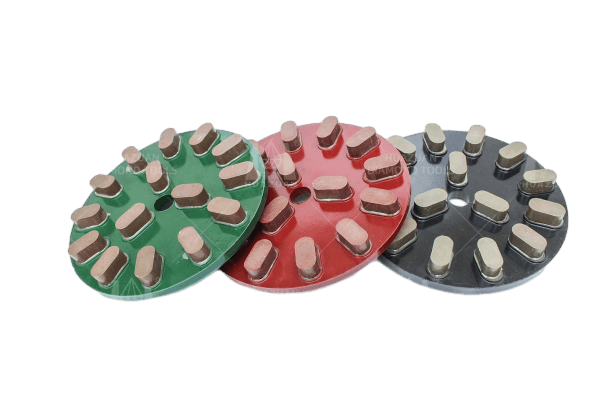
Metal & Resin Bond Grinding Disc for Granite Slab Grinding

Disques de meulage à liant métallique et résine pour le polissage du granit
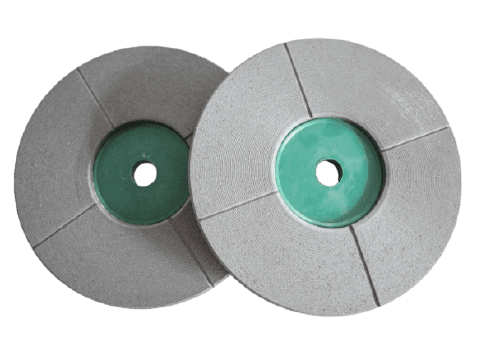
DINOSAW metal and resin bond grinding discs are the disc-format grinding program on granite polishing machines. Metal bond discs handle the coarse grinding stage with grits 50#, 10S#, 200# and 400#, delivering high processing efficiency and a long lifespan of polishing. Resin bond discs handle the fine grinding stage with grits 500#, 800#, 1500# and 3000#, refining the slab surface before polishing discs take the final gloss. Both disc types install on automatic continuous polishing machines or single head grinding machines, and both are available in four diameter classes: 4"/100, 5"/150, 6"/200 and 10"/250 mm. Run metal discs first to level the slab, resin discs second to close the scratch pattern, and the polishing stage receives a surface it can finish at full gloss.
4"-10" (100-250 mm) DiametersFour diameter classes — 4"/100, 5"/150, 6"/200 and 10"/250 mm — match disc-head positions on polishing lines and single head grinding machines.
Metal 50#-400#Metal bond discs take the coarse grinding stage on granite slabs with high processing efficiency and long lifespan of polishing.
Resin 500#-3000#Resin bond discs carry the fine grinding stage, preparing the slab before polishing discs take the final gloss.

Applicable Materials

Granite slabs in polishing-line and single-head grinding production

Certifications & Credentials

CE Certified · ISO 9001:2015 · Industry Standard Drafting Participant · 120+ Countries & Regions Served

Grinding Disc Applications in Granite Slab Production

Grinding discs sit between calibration and polishing: metal discs remove the saw-cut face and level the slab, resin discs refine the surface so polishing heads can finish at uniform gloss.

Real Grinding Performance & Key Metrics

DINOSAW metal and resin bond grinding discs are the disc-format grinding program on granite polishing machines: metal discs take the coarse grinding stage, resin discs take the fine grinding stage, and polishing discs finish the gloss — one mounting system covering every stage between calibration and buffing.

4"/100-10"/250 mm

Four Diameter Classes

Discs are supplied in 4"/100, 5"/150, 6"/200 and 10"/250 mm, so each grinding station on a continuous polishing machine or single head grinding machine gets the diameter its head position requires.

50#, 10S#, 200#, 400#

Metal Bond Coarse Stage

The metal grit program levels granite slabs after cutting or calibration. High processing efficiency removes thickness relief fast, while the metal bond gives a long lifespan of polishing-line duty.

500#, 800#, 1500#, 3000#

Resin Bond Fine Stage

The resin grit program erases the coarse scratch pattern step by step and closes the surface, so the polishing discs downstream take the final gloss instead of fighting deep scratches.

2 Machine Types

Line or Single Head Mounting

The same discs install on automatic continuous polishing machines for production-line flow or on single head grinding machines for station-by-station processing, keeping one disc program across both setups.

Applicable materials: Granite slabs in polishing-line and single-head grinding production.

Typical products: Coarse-ground and fine-ground granite slabs prepared for the final polishing stage on automatic continuous polishing machines and single head grinding machines.

Actual disc life, removal rate and gloss development vary with granite hardness and abrasiveness, grit sequence, head pressure, water delivery and machine settings.

Metal & Resin Grinding Disc Models & Specifications

Choose the bond by process stage and the diameter by machine head. Metal bond discs cover the coarse grinding stage with grits 50#, 10S#, 200# and 400#; resin bond discs cover the fine grinding stage with grits 500#, 800#, 1500# and 3000#. Both are available in the same four diameter classes — 4"/100, 5"/150, 6"/200 and 10"/250 mm — and both mount on automatic continuous polishing machines or single head grinding machines.

SpecificationMetal Bond Grinding DiscResin Bond Grinding Disc
Process stageCoarse grinding of granite slabsFine grinding of granite slabs
Mounting machineAutomatic continuous polishing machine or single head grinding machineAutomatic continuous polishing machine or single head grinding machine
Diameter4"/100, 5"/150, 6"/200, 10"/250 mm4"/100, 5"/150, 6"/200, 10"/250 mm
Grit50#, 10S#, 200#, 400#500#, 800#, 1500#, 3000#
Bond materialMetal bondResin bond
Key characteristicHigh processing efficiency and long lifespan of polishingFine grinding before polishing discs take the final gloss

Core Technology & Abrasive Structure

Six engineering decisions behind the DINOSAW grinding disc program. The numbered points on the disc diagram correspond to the systems below.

Dinosaw machine Metal/Resin bond grinding disc

Grinding Disc Workflow on Polishing Machines

1 · Mount: install the discs on the grinding heads of the automatic continuous polishing machine or single head grinding machine, one grit per station. 2 · Set the sequence: arrange metal bond 50#, 10S#, 200#, 400# in the coarse stations and resin bond 500#, 800#, 1500#, 3000# in the fine stations. 3 · Run: pass granite slabs through with water delivery on, leveling the slab in the metal stage and refining scratches in the resin stage. 4 · Verify & hand over: check flatness and surface after the 3000# station, then feed the slab to the polishing discs for the final gloss.

01

Metal Bond for Coarse Stock Removal

The metal bond locks diamond grit firmly in place, so 50# to 400# discs keep cutting through hard granite relief without premature grain loss. This is what delivers the high processing efficiency and long lifespan of polishing that the coarse stage depends on.

02

Resin Bond for Fine Surface Refinement

The resin bond wears progressively, exposing fresh fine diamond at 500# to 3000# as the surface refines. The gradual exposure keeps the fine stage cutting instead of glazing, which is what prepares the slab for the final polishing discs.

03

Four-Diameter Disc Program

Diameters of 4"/100, 5"/150, 6"/200 and 10"/250 mm let the program follow the machine instead of forcing the machine to one disc size. Each grinding station on a continuous polishing line gets the diameter its head position and working width require.

04

Eight-Grit Stage Coverage

Grits from 50# through 3000# cover the full grinding sequence on one product family: 50#, 10S#, 200# and 400# metal for coarse work, then 500#, 800#, 1500# and 3000# resin for fine work. A continuous grit ladder means each stage erases the previous scratch depth before the next begins.

05

Polishing-Line Mounting Interface

The discs are built for automatic continuous polishing machines and single head grinding machines, with the mounting format matched to the disc heads on these machines. The same interface across both machine types simplifies spare-part planning for factories running mixed equipment.

06

Water-Fed Grinding Zone Design

On the machine, water is delivered to the grinding zone to cool the bond and clear granite slurry. Correct water delivery protects both metal and resin bonds from heat damage and keeps each grit cutting at its intended rate through the shift.

Metal Bond vs. Resin Bond Grinding Discs

Choose by process stage: metal discs remove stock in coarse grinding, resin discs refine the surface before polishing.

Metal Bond vs. Resin Bond Grinding Discs
Metal Bond Grinding DiscVSResin Bond Grinding Disc
Coarse grinding of granite slabsProcess stage✓ Fine grinding of granite slabs
50#, 10S#, 200#, 400#Grit range✓ 500#, 800#, 1500#, 3000#
Metal bondBond material✓ Resin bond
High stock removal, sets slab flatnessRemoval behavior✓ Refines scratch pattern, preps the gloss base
High processing efficiency, long lifespan of polishingKey strength✓ Smooth handover to polishing discs for the final gloss
Continuous polishing machine / single head grinderMounting✓ Same mounting, fine-stage stations
Leveling slabs after cutting or calibrationBest for✓ Preparing the slab surface for final polishing

Note: configurations vary by brand and model; actual performance depends on the specific machine, material and working conditions.

The Manufacturer Behind the DINOSAW Grinding Disc Program

DINOSAW is a manufacturer of CNC stone processing machinery, specializing in diamond wire saw machines and CNC stone cutting equipment. With more than 20 years of R&D and manufacturing experience, DINOSAW contributes to industry standards including T/CMES 41001-2025 for CNC wire saw machines, holds 100+ technical patents, and supplies equipment and technical support to customers in 120+ countries and regions. Its manufacturing and management systems are certified to ISO 9001, ISO 14001 and ISO 45001, with CE-compliant machinery for international markets.

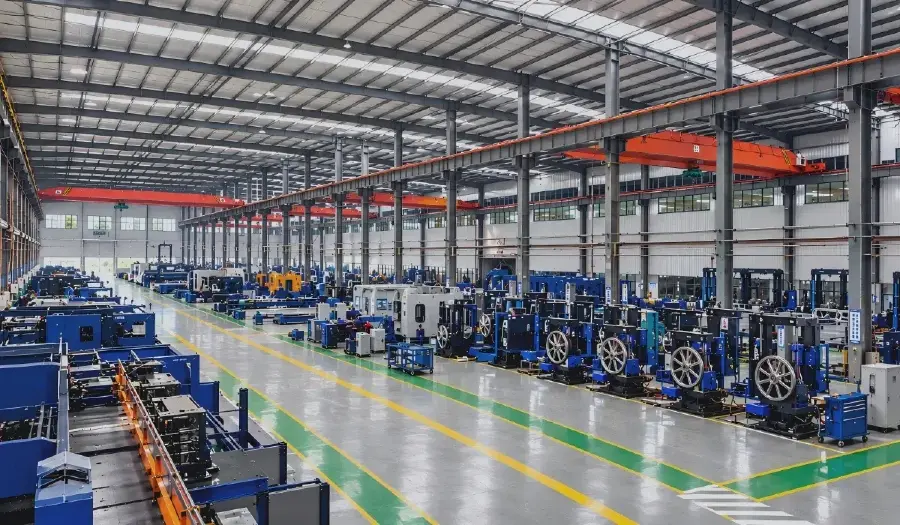
DINOSAW CNC stone machinery manufacturing workshop
DINOSAW R&D & ManufacturingMechanical Design · CNC Control Development · Assembly · Testing · Commissioning · Global Delivery
Industry Standard Drafting

DINOSAW contributes to industry standards for stone machinery, including T/CMES 41001-2025 for CNC wire saw machines, as well as standards covering multi-wire saws, combined wire saw machines and five-axis bridge cutting equipment. This work reflects the company’s long-term involvement in machine design, manufacturing, testing and quality control.

20+Years of Stone Machinery R&D & Manufacturing Experience
100+Technical Patents — Covering machine structures, CNC control, cutting systems and stone processing technologies
120+Countries & Regions Served — Equipment, installation and technical support worldwide

CE Compliance & ISO Management Systems

CE: Stone cutting machinery assessed against Machinery Directive 2006/42/EC and relevant EN standards.
ISO: Management systems certified to ISO 9001, ISO 14001 and ISO 45001.

Installation Requirements & After-Sales Support

DINOSAW provides mounting guidance, grit-sequence planning, remote diagnosis and spare-parts coordination for every grinding disc order.

Mounting InterfaceContinuous polisher or single-head grinder heads

Disc format is matched to the grinding heads on automatic continuous polishing machines and single head grinding machines; send a head photo to confirm fit.

Grit Configuration50#-3000#, configured per stage plan

Metal 50#, 10S#, 200#, 400# for coarse stations and resin 500#, 800#, 1500#, 3000# for fine stations, arranged per your line layout.

Water SupplyLine coolant to the grinding zone

Grinding runs with continuous water delivery to cool the bond and clear slurry; confirm flow at each grinding station before running new discs.

01 · Pre-Shipment & DeliveryMachine configuration, packaging and transport requirements confirmed before dispatch, with factory inspection and documents verified.
02 · Installation & CommissioningOn-site utilities and foundation check, machine positioning, commissioning and acceptance.
03 · Operator TrainingHands-on training covering routine CNC operation and daily checks of blades, spindles, cooling and lubrication.
04 · After-Sales SupportRemote technical assistance, maintenance support and spare parts coordination throughout the machine's service life.

Grinding Disc Selection, Installation & Operation FAQ

Answers to the main buying questions around metal vs. resin bond discs, machine mounting, grit sequences, adjacent tool choices and quotation preparation.

Buy by process stage, not by preference. Metal bond discs are the coarse grinding stage of granite slab production: grits 50#, 10S#, 200# and 400# remove saw marks and thickness relief left by cutting or calibration, so the slab is flat before fine work starts. Their metal bond holds the diamond firmly for high stock removal, delivering high processing efficiency and a long lifespan of polishing-line duty. Resin bond discs are the fine grinding stage: grits 500#, 800#, 1500# and 3000# erase the scratch pattern the metal stage leaves and close the surface so polishing discs can take the final gloss without overworking. Most factories run both on the same machine — metal discs in the first grinding stations, resin discs in the last grinding stations before polishing — and order them as one program so the grit sequence matches. If you only need to level slabs and surface finish is handled elsewhere, metal discs alone may cover the job; if your slabs arrive pre-ground and only need refinement before buffing, resin discs alone are enough. Tell DINOSAW where your slabs enter the sequence, and the team will propose the matching stage split and grit list for your line.

These discs are built for polishing-line machines, so skip them if your work is handheld, site-based, or a different holder format. For handheld grinder work on edges, cutouts and small repairs, choose a cup wheel — it mounts angle grinders, while these discs mount automatic continuous polishing machines or single head grinding machines. If your job is the final buff to gloss, that belongs to polishing discs: grinding discs stop at 3000# fine grinding, and polishing discs take the final gloss afterwards. And if your machine uses a frankfurt or fickert holder system instead of round disc heads, choose frankfurt or fickert abrasives — the holder format is different, and these discs will not fit. Buy these grinding discs when you run a disc-head polishing or grinding machine and need the grinding stages between calibration and polishing: metal discs for coarse grinding, resin discs for fine grinding. A quick way to confirm fit before ordering is to send a photo of your machine's grinding head and the abrasive you currently use; DINOSAW will verify the mounting format and recommend the correct grit sequence for your granite slabs.

Send five things: your machine model, disc diameter, the grits you need, your granite type, and your monthly consumption. The machine model — automatic continuous polishing machine or single head grinding machine — plus a photo of the grinding head confirms the mounting interface. Diameter is chosen from four standard classes: 4"/100, 5"/150, 6"/200 and 10"/250 mm, matched to your head positions. For grits, state the stage split: metal bond 50#, 10S#, 200#, 400# for coarse grinding, resin bond 500#, 800#, 1500#, 3000# for fine grinding — or both if you are setting up the full sequence from scratch. Granite hardness and abrasiveness influence bond advice and consumption estimates, so name the stone or send a sample photo. Monthly disc consumption, or the disc life you currently achieve, lets DINOSAW propose a supply plan with quantity tiers instead of quoting a single box price. Finally, include the destination country for packing and shipping planning. With these five items, the quotation comes back with the correct diameter, grit list and volume pricing rather than a generic price list.

Both disc types install on the same machines: an automatic continuous polishing machine or a single head grinding machine. On a continuous polishing line, discs are arranged across the grinding bridge in stations and the slab passes under them in one continuous flow; on a single head grinding machine, the operator processes the slab section by section. Either way, the working sequence runs metal first, resin second: 50# and 10S# metal discs level the slab and remove the saw-cut face, 200# and 400# metal discs refine the flatness, then 500#, 800#, 1500# and 3000# resin discs step the surface toward a polishable base. Each grit must erase the previous scratch depth before the next one works, so skipping grits to save discs usually costs more time at the polishing stage than it saves at grinding. Before running a new batch, check two things: that every head in a station carries the same grit, and that water reaches the grinding zone, because grinding granite without coolant overheats the bond and wastes disc life on both metal and resin discs.

Metal discs deliver high processing efficiency and long lifespan in coarse grinding; resin discs wear faster by design at the fine stage — plan the budget separately for each. In the coarse stage, the metal bond wears slowly and holds the diamond grit firmly, so 50# to 400# discs typically serve many shifts before cutting action fades; exact life depends on granite hardness, slab throughput and head pressure. Resin bonds are softer so they release worn diamond gradually and keep fresh edges cutting at 500# to 3000#, which means finer discs consume faster and should be treated as a recurring consumable line item. Track two numbers per station — slabs processed per disc and gloss after polishing — and reorder when either drifts from your baseline. If metal disc life runs short on your stone, the cause is usually excessive head pressure or insufficient water rather than the disc itself; if resin discs load up and stop cutting, check that the metal stage fully removed the coarse scratches first. Send your current consumption figures with an inquiry and DINOSAW will suggest a grit plan and diameter mix that balances disc cost against polishing-line speed.

Contact Dinosaw

Discuss Grinding Disc Specifications, Grit Sequences & Pricing

Are you looking for the perfect cutting machines or processing solutions for hard and brittle materials?

Facing challenges in stone quarrying, countertop cutting, concrete and underwater pipeline cutting, stainless steel rust removal and grinding, luxury thin slab cutting, agate and gemstone cutting, graphite cutting, or even building demolition?

Leave your inquiry, and you can expect a reply within 12 hours with tailored solutions!

Prefer email?

You can also reach us at

gma@dinosawmachine.com
Metal & Resin Bond Grinding Disc for Granite Slab Grinding

What materials will you be working with? *

Your Name / Company Name? *

Phone Number / Email Address? *

+86

What specific requirements do you have?

Get A Easy Solution

Chat Online
Ms.Lizzy

Hi, this is Lizzy from Dinosaw ( Not a Robot ).  Which Machine ( model ) do you want? Please WhatsApp us now

WhatsApp Chat Now
Contact Us

Hello 👋 How can we help?