Disque de polissage haute efficacité pour dalles de granit et finition fine
DINOSAW
The DINOSAW LBJ series is a quarry chain saw machine for mechanized dry cutting of marble, sandstone and other soft to medium-hard stratified stone. A diamond chain cuts straight, deep faces in both horizontal and vertical directions without process water, with three depth classes at 3,200, 4,500 and 5,600 mm. PLC control manages the cutting cycle, while the hydraulic system automatically adjusts cutting parameters with stone hardness. An IoT remote data collection module and a wireless remote control are available as factory options for quarries running multiple machines or high benches. The LBJ fits quarries where diamond wire sawing is uneconomical on soft stone, and it works alongside the KSSJ wire saw rather than replacing it: in the high-bench extraction method, the chain saw separates one connecting face while the wire saw cuts the other two.
BUFF GritFinal-stage grit class, mounted after the grinding disc sequence on continuous polishers and single head machines.
100–250 mmFour standard diameters — 100, 180, 200 and 250 mm — matched to common polishing head sizes.
White / Black BuffTwo buff variants: white buff for standard final gloss, black buff as the closing step for dark granite.
Applicable Materials
Granite slabs, including light grey and white granite such as G603, dark grey granite such as G654, and black granite such as Absolute Black and Black Galaxy
Certifications & Credentials
CE Certified · ISO 9001:2015 · Industry Standard Drafting Participant · 120+ Countries & Regions Served
Buff discs run at the last station of slab polishing lines, where slabs arriving calibrated and fully refined receive their final gloss pass before packing and dispatch.
Final Gloss on Continuous Polishing Lines
Mount the buff disc on the last heads of an automatic continuous polishing machine, after the coarse and fine grinding disc sequence. The final station closes the gloss on calibrated granite slabs as they pass through the line — the standard duty this disc is built for.
White Buff for Light & Grey Granite
Run the white buff variant as the closing pass on light grey, white and mid-grey granite programs such as G603. On these colors the white buff delivers the specified final gloss without tinting the surface.
Black Buff for Dark & Black Granite
Specify the black buff where the program covers dark grey or black granite such as G654, Absolute Black or Black Galaxy. Many lines run the black buff after the white sequence so the stone's deep tone survives the final pass.
Single Head Grinding Machine Finishing
The same buff discs mount on single head grinding machines for batch final polishing where a full continuous line is not justified — small slab programs, remakes and cut-to-size finishing.
Polishing Line Retrofits & Consumable Replacement
Match new buff discs to existing holders by machine model and disc diameter — 100, 180, 200 or 250 mm. Send the current disc specification and line grit sequence so DINOSAW aligns the buff program with the grinding discs already running upstream.
Real Polishing Performance & Key Metrics
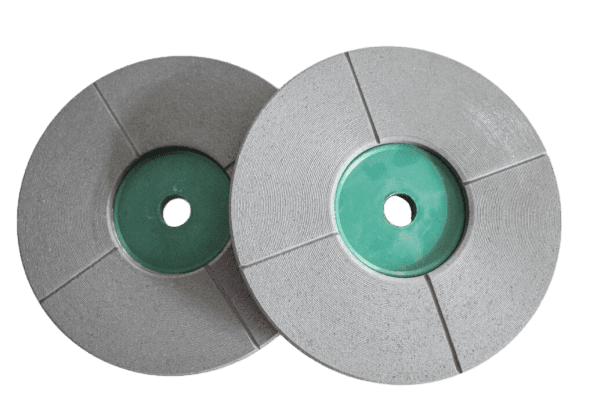
The DINOSAW polishing disc is the final gloss station of granite line polishing: a buff disc mounted after the grinding disc sequence on automatic continuous polishing machines or single head grinding machines, in white or black buff per line practice.
BUFF Grit
Final-Stage Grit Class
The buff grit is reserved for the closing station after coarse and fine grinding discs, so the slab reaches the final pass fully refined and the buff disc works on finish quality instead of removal.
100–250 mm
Four Standard Diameters
Diameters of 100, 180, 200 and 250 mm match the head sizes used on continuous line polishers and single head grinding machines, so existing holders and adapters can usually be kept.
White / Black Buff
Two Buff Variants
White buff serves as the standard final pass, while black buff closes dark and black granite programs where a light buff can mute the stone's deep tone.
Long Lifespan
Efficiency & Disc Life
High processing efficiency and long lifespan of polishing keep the final station cycling with fewer disc changes per shift, which protects line throughput on multi-shift slab programs.
Applicable materials: Granite slabs, including light grey and white granite such as G603, dark grey granite such as G654, and black granite such as Absolute Black and Black Galaxy.
Typical products: Polished granite slabs for countertops, vanity tops, tiles, cut-to-size programs and monument work that carry a final gloss specification.
Actual gloss level, processing efficiency and disc life vary with stone hardness and color, preceding grinding disc condition, line parameters, water supply and operator settings.
Polishing Disc Program Specifications
Buff discs are line consumables rather than standalone models: choose the disc diameter to match the polishing head holder — 100, 180, 200 or 250 mm — then select the buff color per line practice. White buff is the standard final pass; black buff is specified for dark and black granite programs. Confirm the holder or adapter interface at order so the discs mount directly on your continuous polisher or single head grinding machine.
Specification
DINOSAW Polishing Disc (Buff)
Application
Final polishing of granite slabs
Machine type
Automatic continuous polishing machine or single head grinding machine
Diameter (mm)
100 / 180 / 200 / 250
Grit
BUFF
Buff color
White / Black
Core Technology & Abrasive Structure
Four engineering decisions behind the DINOSAW buff disc program. The numbered points on the disc diagram correspond to the structure below.
Buff Disc Final Polishing Workflow
A buff disc run follows four steps: 1 · Mount: fit the buff disc on the final-station head of the continuous polisher or single head grinding machine, confirming the holder and diameter match. 2 · Set: set line pressure, speed and water for the final pass, with the grinding disc sequence already completed upstream. 3 · Run: pass the slab through the final station — white buff for standard programs, black buff as the closing step for dark granite. 4 · Inspect & unload: check gloss against the program specification, then unload and pack the slab for dispatch.
01
Buff-Grade Abrasive Layer
The working layer uses buff-grade abrasive engineered for the final pass rather than removal. After the grinding disc sequence has refined the surface, the buff layer closes the gloss without forcing the line to slow down, which is where the program's high processing efficiency comes from.
02
Diameter-Matched Disc Body
Four standard diameters — 100, 180, 200 and 250 mm — let the disc program follow the head layout of the polishing machine instead of forcing adapter stacks. Correct seat diameter keeps runout low at final-stage speeds, where surface quality is decided.
03
White & Black Buff Program
White buff is the standard closing disc for most granite programs. Black buff is specified where dark and black granites need their deep tone preserved to the last pass. Lines can hold one program for mixed colors or sequence both per line practice.
04
Water-Cooled Final Pass
The final pass runs wet on both continuous polishers and single head machines. Correct water delivery clears the polishing zone, controls heat at the buff surface and supports the long lifespan of polishing the program is built around.
05
Line-Program Consumable Design
The buff disc is engineered as a consumable of the polishing line: four diameters and two buff colors map directly onto common head layouts and granite color programs. Ordering follows the existing grit sequence, so the final station stays matched to the grinding discs upstream.
06
End-of-Line Quality Control Point
The final station is where gloss is verified before packing, and the buff disc is the tool at that checkpoint. A stable buff pass makes the gloss reading predictable across the shift, so quality checks catch drift early instead of after dispatch.
Buff Disc Final Polish vs. Oxalic Acid Final Polish
Choose the final stage of granite line polishing: mechanical buff discs or magnesite oxalic acid blocks.
Buff Disc Final Polish vs. Oxalic Acid Final Polish
Magnesite Oxalic Acid Final Stage
VS
DINOSAW Buff Polishing Disc
Chemical-mechanical: oxalic acid brightening combined with magnesite abrasive
Polishing mechanism
✓Mechanical buff pass with water only
Requires acid storage, dosing and line rinsing
Chemistry handling
✓No acid chemistry on the line
Best on granites that respond to oxalic acid brightening
Stone fit
✓White buff for light granite, black buff for dark granite programs
Final heads of the polishing line
Machine type
✓Automatic continuous polishing machine or single head grinding machine
Adds chemical dosing and extra rinsing upstream of packing
Line integration
✓Mounts like any disc; rinsing follows the standard wet pass
Acid-magnesite blocks consumed by the pass
Consumable program
✓100 / 180 / 200 / 250 mm buff discs built for long polishing lifespan
Reactive stones where acid brightening lifts the final gloss
Best for
✓Final gloss across light and dark granite without acid chemistry
Note: configurations vary by brand and model; actual performance depends on the specific machine, material and working conditions.
The Manufacturer Behind the DINOSAW Polishing Disc Program
DINOSAW is a manufacturer of CNC stone processing machinery, specializing in diamond wire saw machines and CNC stone cutting equipment. With more than 20 years of R&D and manufacturing experience, DINOSAW contributes to industry standards including T/CMES 41001-2025 for CNC wire saw machines, holds 100+ technical patents, and supplies equipment and technical support to customers in 120+ countries and regions. Its manufacturing and management systems are certified to ISO 9001, ISO 14001 and ISO 45001, with CE-compliant machinery for international markets.
DINOSAW R&D & ManufacturingMechanical Design · CNC Control Development · Assembly · Testing · Commissioning · Global Delivery
Industry Standard Drafting
DINOSAW contributes to industry standards for stone machinery, including T/CMES 41001-2025 for CNC wire saw machines, as well as standards covering multi-wire saws, combined wire saw machines and five-axis bridge cutting equipment. This work reflects the company’s long-term involvement in machine design, manufacturing, testing and quality control.
20+Years of Stone Machinery R&D & Manufacturing Experience
100+Technical Patents — Covering machine structures, CNC control, cutting systems and stone processing technologies
120+Countries & Regions Served — Equipment, installation and technical support worldwide
CE Compliance & ISO Management Systems
CE: Stone cutting machinery assessed against Machinery Directive 2006/42/EC and relevant EN standards. ISO: Management systems certified to ISO 9001, ISO 14001 and ISO 45001.
Installation Requirements & After-Sales Support
Buff discs mount on the customer's existing polishing machine, so preparation focuses on head compatibility: confirm the holder or adapter interface, machine type and buff color program before the first order. DINOSAW provides mounting guidance, parameter recommendations, remote diagnosis and spare-parts coordination for the disc program.
Head Mounting & Adapters100 / 180 / 200 / 250 mm diameters, configured per destination
Disc diameter and holder interface are confirmed against the polishing machine model at order, so the discs seat directly on existing heads.
Polishing Machine CompatibilityContinuous polisher or single head grinding machine
Specify the machine brand, model and head count so the buff discs are matched to the final station layout.
Water SupplyWet final pass, supplied by the polishing machine
The final pass runs wet; water delivery follows the polishing machine's existing cooling and slurry system.
01 · Pre-Shipment & DeliveryMachine configuration, packaging and transport requirements confirmed before dispatch, with factory inspection and documents verified.
02 · Installation & CommissioningOn-site utilities and foundation check, machine positioning, commissioning and acceptance.
03 · Operator TrainingHands-on training covering routine CNC operation and daily checks of blades, spindles, cooling and lubrication.
04 · After-Sales SupportRemote technical assistance, maintenance support and spare parts coordination throughout the machine's service life.
How to place the buff disc at the end of a granite polishing line, when it is the wrong tool, and what to prepare before ordering.
Choose the buff disc when the slab only needs its final gloss, not material removal or refinement. In a granite line the work splits by station: coarse and fine grinding discs level and refine the surface, the buff disc closes the gloss. If your slabs still arrive with saw marks, lippage or scratch to remove, start with grinding discs — a buff disc mounted on an unrefined surface wears out fast and delivers little gloss. Choose machine discs over handheld polishing pads when slabs run on a continuous polisher or single head grinding machine; flexible pads belong to manual work, not line duty. As the final stage, the buff disc is also the main alternative to a magnesite oxalic acid block: the buff disc works mechanically with water only, while the acid block adds chemical brightening for reactive stones. If the line already ends on acid blocks and the gloss specification is being met, keep that route; if you want to drop acid handling or your stone responds poorly to chemistry, the buff disc is the natural replacement.
Send five groups of data and the quotation becomes a configuration, not a guess. First, the machine: brand, model and type — automatic continuous polishing machine or single head grinding machine — plus the number of final-station heads. Second, the interface: the disc diameter currently mounted, 100, 180, 200 or 250 mm, and the holder or adapter specification, so mounting is confirmed before shipment. Third, the stone program: granite varieties and colors, for example G603, G654 or Absolute Black, plus the target gloss level from your specification sheet. Fourth, the line grit sequence from calibrating through the buff station, so the buff disc is matched to the grinding discs running upstream. Fifth, consumption: monthly slab volume and current disc change intervals, which set order quantity and lead time. With these, DINOSAW confirms diameter, white or black buff per line practice, recommended quantity and delivery schedule, and can coordinate the program with grinding discs from the same line.
Yes — many lines hold both variants and switch by program, and some sequence them in the same run. White buff is the standard final pass: it closes the gloss on light grey, white and mid-grey granite without tinting the surface. Black buff is specified where the stone is dark grey or black — G654, Absolute Black, Black Galaxy — because a light-colored buff can leave the surface looking muted and a black buff restores the deep tone customers pay for. Per line practice: single-program lines usually standardize on white buff and only switch to black when a dark granite order arrives; premium programs often run white buff first and close with one or two black buff heads in the same pass. The switch is a head-by-head mounting change, not a line rebuild, so mixed-color factories can respond to orders without stopping production. The practical rule: match the buff color to the darkest stone in the current program, and keep both variants in stock if your order book mixes light and dark granites.
Match the disc diameter to the head holder, not to the slab size. The program covers four standard diameters — 100, 180, 200 and 250 mm — and each corresponds to a common polishing head size on automatic continuous polishing machines and single head grinding machines. Measure the disc diameter currently mounted on the final station, or check the machine manual for the head holder specification, and order that size. Check the interface as well: the backing and mounting of the holder or adapter must accept the new disc, and confirming this at order avoids adapter stacks that add runout exactly where the surface finish is decided. If your machine carries several head sizes across the line, confirm which heads run the buff station — some lines close with the largest heads, others with the smallest. Send the machine brand, model and a photo of the mounted disc to DINOSAW and the diameter and interface are confirmed before the first shipment, so production starts without a mounting mismatch on the final station.
The buff pass delivers the final gloss, but the number is set by the whole line, not by the last disc alone. The buff station can only close gloss on a surface the grinding disc sequence has already refined: if upstream heads leave scratch or unevenness, the buff pass will not correct it. Stone matters too — hard, fine-grained granites generally take a deeper final gloss than coarse or resin-rich ones, and dark stones show gloss differences more clearly than light ones. Line parameters decide the rest: head pressure, line speed, water delivery and disc age all move the reading. A new buff disc on a well-set line starts at the top of its range and drifts as it wears, which is why factories track gloss per shift and change final-station discs on a schedule rather than after gloss fails. Define the target as a glossmeter reading on your specification sheet, measure it on the first slabs of a run, and log the values per stone type. If the reading falls short with fresh discs, the cause is usually upstream — review the grinding sequence before blaming the final station.
Are you looking for the perfect cutting machines or processing solutions for hard and brittle materials?
Facing challenges in stone quarrying, countertop cutting, concrete and underwater pipeline cutting, stainless steel rust removal and grinding, luxury thin slab cutting, agate and gemstone cutting, graphite cutting, or even building demolition?
Leave your inquiry, and you can expect a reply within 12 hours with tailored solutions!
















 English
 中文