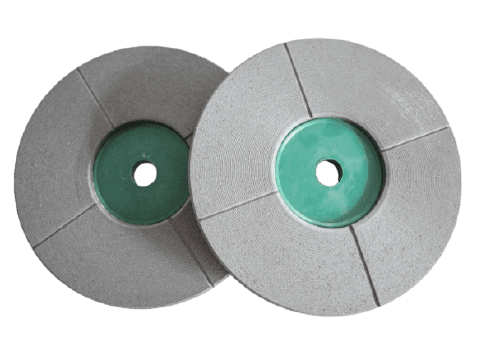
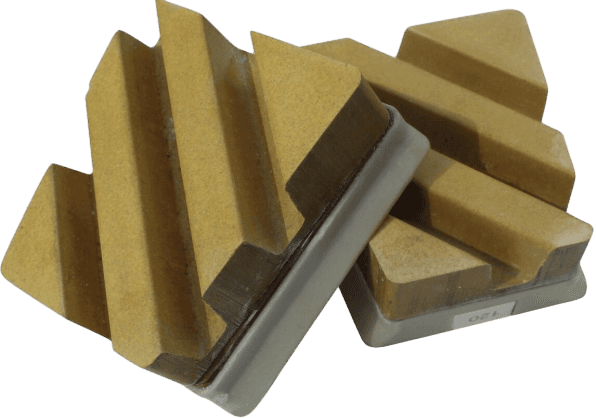
Resin Bond Diamond Frankfurt Abrasives for Stone Slab Polishing

Frankfurt de diamante com resina para polimento de chapas de mármore
The DINOSAW YHMP-10/12 stone arc-slab polishing machine polishes circular column slabs under PLC control, with vacuum fixation holding the curved slab more reliably than two-side gripping. Ten or twelve polishing heads work across a 350–2,000 mm machinable length, making the machine the finishing stage of the curved-column workflow after the YHQJ trims the slab edges.
Dozens of TimesWorking life far beyond traditional abrasives, cutting abrasive changes on hard stone to a fraction of the current frequency.
40#–3000# + BUFFOne resin program carries granite, marble, engineered quartz and terrazzo from first polish to final gloss.
Frankfurt FormatStandard Frankfurt holder fits existing polishing heads; grit changes are swaps within the same head.

Applicable Materials

Granite, marble, engineered quartz, terrazzo and similar stones in slab and tile polishing

Certifications & Credentials

CE Certified · ISO 9001:2015 · Industry Standard Drafting Participant · 120+ Countries & Regions Served

Resin Bond Diamond Frankfurt Applications & Materials

Resin bond Frankfurts work at the finishing stage of production polishing lines, wherever slabs and tiles must reach a specified honed, satin or high-gloss surface after the grinding stage.

Real Polishing Performance & Key Metrics

The DINOSAW resin bond diamond Frankfurt program is the finishing-stage abrasive line for production stone polishing: 16 grits from 40# to 3000# plus BUFF on the standard Frankfurt holder, with working life dozens of times longer than traditional abrasives — fewer tool changes, longer continuous runs and steadier gloss across every shift.

Dozens of Times

Working Life vs. Traditional Abrasives

The resin bond matrix releases worn diamond crystals and exposes fresh cutting edges at a controlled rate, so each Frankfurt lasts dozens of times longer than traditional abrasives on the same stone and the same head.

40#–3000# + BUFF

Full Grit Ladder

Sixteen grit steps from 40# to 3000#, plus the BUFF step, let one program carry the surface from initial polish through final gloss without changing abrasive technology mid-line.

Long Continuous Runs

Stable Processing

Long uninterrupted operation between changes keeps each grit step cutting under steady conditions, so polishing quality stays consistent across the whole production run instead of resetting after every tool change.

Frankfurt Format

Holder Compatibility

The standard Frankfurt geometry mounts directly on existing polishing heads, so adopting the resin program does not require head or holder modifications on compatible machines.

Applicable materials: Granite, marble, engineered quartz, terrazzo and similar stones in slab and tile polishing.

Typical products: Polished granite and marble slabs, quartz surface plates, terrazzo tiles and cut-to-size components with honed, satin or high-gloss finishes.

Actual working life, polishing rate and gloss development vary with stone hardness and abrasiveness, starting surface condition, grit sequence, machine settings and water quality.

Resin Bond Frankfurt Grit & Format Specifications

Selection starts from the surface condition: slabs arriving from the metal bond grinding stage begin at 40# or 60#, partially prepared surfaces start finer, and the program runs step by step to the target finish, ending with BUFF where high gloss is required. All grits share the same Frankfurt holder, so the only variable to plan is the grit sequence and the quantity per head.

SpecificationResin Bond Diamond Frankfurt
BondResin
AbrasiveDiamond
Grit range40#, 60#, 80#, 100#, 120#, 180#, 220#, 320#, 400#, 600#, 800#, 1000#, 1200#, 1500#, 2000#, 3000#
Final stepBUFF
Holder formatFrankfurt
Working life vs. traditional abrasivesDozens of times longer

Core Technology & Abrasive Structure

Six engineering decisions behind the resin bond Frankfurt program. The numbered points on the abrasive diagram correspond to the systems below.

Dinosaw machine Resin bond diamond frankfurt

Resin Bond Frankfurt Polishing Workflow

1 · Mount: seat the selected grit Frankfurts on each polishing head and confirm the holder locks. 2 · Set the sequence: plan the grit path from the starting surface condition up to the target finish, with BUFF last where high gloss is required. 3 · Run polishing passes: process slabs continuously with consistent pressure and water, letting each step remove the previous scratch pattern. 4 · Inspect & advance: check gloss and scratch removal at the end of each step, then swap to the next grit within the same head and continue until the target finish is reached.

01

Controlled-Wear Resin Bond Matrix

The resin matrix is formulated to hold diamond grit firmly under polishing loads while releasing crystals that have rounded off, exposing fresh cutting edges at a controlled rate. This balance is what converts a higher unit price into a working life dozens of times longer than traditional abrasives.

02

16-Step Diamond Grit Ladder

Sixteen graded steps from 40# to 3000# let each step remove the scratch pattern of the one before it. A continuous ladder instead of large jumps protects finer abrasives from removal work they are not designed for, which is where unexpected scratch defects usually come from.

03

Frankfurt Holder Geometry

The Frankfurt format is the long-established standard holder for stone polishing heads. Matching this geometry means the resin program installs on existing heads without modification, and grit changes are seat-and-lock swaps rather than holder rebuilds.

04

Long-Run Continuous Cutting Design

Because each Frankfurt runs far longer than traditional abrasives, a matched set keeps the head in the cut through whole production runs. Continuous operation removes the quality reset that follows every tool change, which is the mechanism behind the stable processing quality.

05

Low-Changeover Head Economics

Every avoided tool change returns the head to cutting time and removes the cleaning, refitting and settling passes that follow a change. On multi-head lines running multiple shifts, the changeover time saved becomes a direct production-efficiency gain.

06

BUFF Final-Gloss Step

The BUFF step closes the program after 3000#, bringing the surface to final gloss without a separate abrasive technology. Running BUFF on the same Frankfurt holder keeps the final step inside the same changeover routine as the rest of the ladder.

Resin Bond Diamond Frankfurt vs. Traditional Magnesite Frankfurts

A program-level comparison for polishing lines deciding between the long-life resin diamond program and the traditional magnesite routine.

Resin Bond Diamond Frankfurt vs. Traditional Magnesite Frankfurts
Traditional Magnesite FrankfurtsVSResin Bond Diamond Frankfurts
Magnesite / synthetic, traditional programBond type✓ Resin bond with diamond grit
Short; consumed within hours to single shifts on hard stoneWorking life✓ Dozens of times longer than traditional abrasives
Frequent changes interrupt the polishing lineTool change frequency✓ Long continuous runs between changes
Quality varies around each abrasive changeProcessing stability✓ Steady quality across continuous runs
Limited, technology-dependent selectionGrit range✓ 16 grits from 40# to 3000#, plus BUFF
FrankfurtHolder format✓ Frankfurt
Very low-volume, occasional or restoration polishingBest for✓ Production polishing lines on granite, marble, engineered quartz and terrazzo

Note: configurations vary by brand and model; actual performance depends on the specific machine, material and working conditions.

The Manufacturer Behind the DINOSAW Abrasive Program

DINOSAW is a manufacturer of CNC stone processing machinery, specializing in diamond wire saw machines and CNC stone cutting equipment. With more than 20 years of R&D and manufacturing experience, DINOSAW contributes to industry standards including T/CMES 41001-2025 for CNC wire saw machines, holds 100+ technical patents, and supplies equipment and technical support to customers in 120+ countries and regions. Its manufacturing and management systems are certified to ISO 9001, ISO 14001 and ISO 45001, with CE-compliant machinery for international markets.

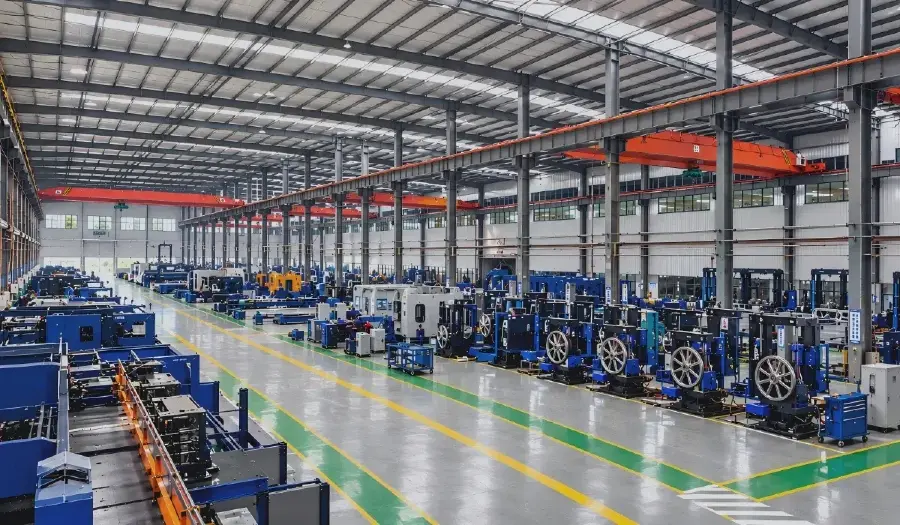
DINOSAW CNC stone machinery manufacturing workshop
DINOSAW R&D & ManufacturingMechanical Design · CNC Control Development · Assembly · Testing · Commissioning · Global Delivery
Industry Standard Drafting

DINOSAW contributes to industry standards for stone machinery, including T/CMES 41001-2025 for CNC wire saw machines, as well as standards covering multi-wire saws, combined wire saw machines and five-axis bridge cutting equipment. This work reflects the company’s long-term involvement in machine design, manufacturing, testing and quality control.

20+Years of Stone Machinery R&D & Manufacturing Experience
100+Technical Patents — Covering machine structures, CNC control, cutting systems and stone processing technologies
120+Countries & Regions Served — Equipment, installation and technical support worldwide

CE Compliance & ISO Management Systems

CE: Stone cutting machinery assessed against Machinery Directive 2006/42/EC and relevant EN standards.
ISO: Management systems certified to ISO 9001, ISO 14001 and ISO 45001.

Installation Requirements & After-Sales Support

DINOSAW provides installation guidance, operator training, remote diagnosis and spare-parts coordination for every machine.

Grit Configuration40#–3000# + BUFF

The grit sequence and quantity per polishing head are configured around your stone, starting surface condition and target finish.

Holder CompatibilityFrankfurt format

Confirm the Frankfurt holder geometry matches your polishing heads before ordering; fickert-style heads use the resin fickert program instead.

Order & SupplyPackaging & delivery configured per destination

Order quantity, packaging and shipment terms are confirmed per order and destination region.

01 · Pre-Shipment & DeliveryMachine configuration, packaging and transport requirements confirmed before dispatch, with factory inspection and documents verified.
02 · Installation & CommissioningOn-site utilities and foundation check, machine positioning, commissioning and acceptance.
03 · Operator TrainingHands-on training covering routine CNC operation and daily checks of blades, spindles, cooling and lubrication.
04 · After-Sales SupportRemote technical assistance, maintenance support and spare parts coordination throughout the machine's service life.

Resin Bond Diamond Frankfurt Selection, Installation & Operation FAQ

Answers to the main buying questions around switching from traditional abrasives, grit sequence planning, adjacent product selection and quotation preparation.

Traditional magnesite Frankfurts have served stone polishing for decades, but they wear quickly on hard stone: a magnesite block can be consumed within a single shift of granite polishing, so the operator stops the head, cleans the holder, fits new abrasives and waits for the fresh set to settle several times per day. DINOSAW resin bond diamond Frankfurts are specified to last dozens of times longer than traditional abrasives, because the diamond grit is held in a resin matrix engineered to release worn crystals and expose fresh cutting edges at a controlled rate. The practical effect goes beyond lower abrasive consumption: every avoided tool change returns the polishing heads to cutting time, and the long continuous run between changes lets each grit step work under steady conditions, which is what makes the final gloss consistent across the slab. Shops comparing the two on purchase price alone often miss this point — the resin program carries a higher unit price but replaces magnesite many times over, removes repeated changeover labor, and reduces the risk of a fresh abrasive marking the surface in its first passes. For high-volume lines the economics strongly favor resin; for very low-volume or occasional restoration work, magnesite can still be rational.

Resin bond Frankfurts cover the finishing stage, roughly 40# through 3000# plus BUFF; outside that window, adjacent DINOSAW products are the right choice. For the grinding stage that removes saw marks and levels the slab — where aggressive stock removal and impact loading dominate — choose metal bond diamond Frankfurts, which hold their form under the loads that would strip a resin matrix. For very low-volume or restoration polishing where the machine runs only occasionally, the traditional magnesite or synthetic program remains a rational, low-cost option despite its short life. And if your machine uses a fickert-style holder rather than a Frankfurt head, choose the resin bond fickert: the abrasive technology is similar but the holder geometry is different, so the two are not interchangeable. Choose the resin bond Frankfurt when you run production polishing on granite, marble, engineered quartz or terrazzo and want one continuous program from initial polish through the buff step with the fewest possible tool changes. A practical selection sequence: confirm your holder format first, then the stone and starting surface condition, then map the required finish against the grit ladder — rougher starting surfaces begin at 40# or 60#, while surfaces already ground can start at 120# or finer, saving both time and abrasive cost.

The DINOSAW resin bond Frankfurt program spans 16 grits — 40#, 60#, 80#, 100#, 120#, 180#, 220#, 320#, 400#, 600#, 800#, 1000#, 1200#, 1500#, 2000# and 3000# — followed by the BUFF step for the final gloss. The standard rule is to never skip more than one or two grit steps, because each step must remove the scratch pattern the previous step left behind: jumping from 120# to 400#, for example, forces the 400# abrasive to do removal work it is not designed for, which shortens its life and can leave scratches that only reappear after the buff. A typical granite program runs 60# or 80# to remove the marks left by the metal bond grinding stage, then 120#–220# for honing, 400#–800# for smoothing, 1200#–3000# for pre-polish, and BUFF for final gloss. Marble and softer stones can usually start finer and finish earlier, while engineered quartz often needs the full ladder to close the surface before buffing. Because every step uses the same Frankfurt holder, changing grits is a seat-and-lock swap rather than a holder change, which is what keeps the long resin-bond runs efficient in daily operation.

To quote resin bond diamond Frankfurts accurately, send five pieces of information. First, your machine: brand, model and polishing-head type, with the holder format confirmed as Frankfurt — this fixes the mounting geometry and the number of abrasives per head. Second, your stone: granite, marble, engineered quartz, terrazzo or another material, plus its hardness and color, because resin formulation and diamond grade are selected against the stone's abrasiveness. Third, the surface condition before polishing — whether slabs arrive from a metal bond grinding stage, from a calibrating machine, or already partially polished — which determines the starting grit. Fourth, your target finish: honed, satin or high gloss, which defines how far up the ladder the program must run and whether BUFF is required. Fifth, consumption data: heads per machine, shifts per day and current abrasive usage per square meter, so DINOSAW can estimate the life multiple and the real cost per slab against your present program. With these inputs the quotation can specify the recommended grit sequence, the quantity per step, packaging and delivery terms — rather than a generic per-piece price that ignores how the abrasives will actually run on your line.

The efficiency gain from resin bond Frankfurts comes from the structure of the polishing shift, not from a faster cutting speed per pass. With traditional abrasives the operator repeatedly stops the line, waits for the head, unscrews worn abrasives, cleans the holder seats, fits replacements and restarts — a cycle that can occur many times per shift on hard granite. Each interruption is lost production time, and each fresh abrasive needs several passes before it settles into a steady cut, which shows up as quality variation on the first slabs after every change. Because DINOSAW resin bond Frankfurts run dozens of times longer, a matched set keeps cutting through whole production runs without interruption: the heads stay in the cut, the removal rate stays steady, and surface quality stays stable from the first slab to the last. Fewer changes also mean less handling wear on holders and fewer re-balancing routines. When evaluating the switch, compare cost per polished square meter rather than cost per abrasive — divide your current abrasive spend by your current output, then ask DINOSAW to model the same figure for the resin program using your stone, grit sequence and daily volume. That figure, not the catalog price, is the number that decides the purchase.

Contact Dinosaw

Discuss Resin Bond Diamond Frankfurt Pricing, Configuration & Application

Are you looking for the perfect cutting machines or processing solutions for hard and brittle materials?

Facing challenges in stone quarrying, countertop cutting, concrete and underwater pipeline cutting, stainless steel rust removal and grinding, luxury thin slab cutting, agate and gemstone cutting, graphite cutting, or even building demolition?

Leave your inquiry, and you can expect a reply within 12 hours with tailored solutions!

Prefer email?

You can also reach us at

gma@dinosawmachine.com
Resin Bond Diamond Frankfurt Abrasives for Stone Slab Polishing

What materials will you be working with? *

Your Name / Company Name? *

Phone Number / Email Address? *

+86

What specific requirements do you have?

Get A Easy Solution

Chat Online
Ms.Lizzy

Hi, this is Lizzy from Dinosaw ( Not a Robot ).  Which Machine ( model ) do you want? Please WhatsApp us now

WhatsApp Chat Now
Contact Us

Hello 👋 How can we help?