




 中文


Ms.Lizzy
Hi, this is Lizzy from Dinosaw ( Not a Robot ). Which Machine ( model ) do you want? Please WhatsApp us now


Open Hours:8:30am-20:30pm

WhatsApp: +86 198-5901-3937

 Nov 5, 20266 MIN READ
 Nov 5, 20266 MIN READ
Learn how to choose the right granite drill bit, compare core bits and hole saws, select wet or dry drilling, check RPM factors, and drill granite with less chipping.
Granite is hard, abrasive, and unforgiving when the wrong drilling setup is used. The right granite drill bit depends on more than the material alone: hole diameter, slab thickness, drilling machine, wet or dry operation, and the required edge quality all affect the choice.
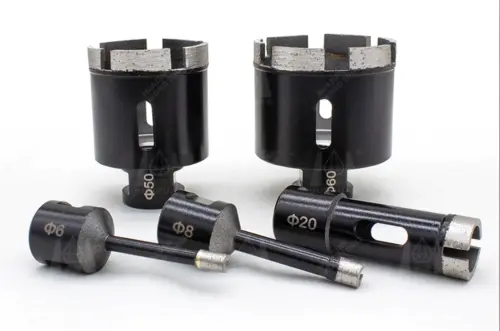
For most finished granite work, diamond tooling is the preferred starting point. Diamond core drill bits are commonly used for larger round holes such as faucet, fixture, and service openings, while diamond hole saws and smaller diamond drill bits can suit other installation and anchoring tasks.
There is also no single RPM that works for every granite drill bit. Recommended speed changes with bit diameter, construction, machine, and whether the tool is designed for wet or dry drilling.
For production stone fabrication, see DINOSAW’s Diamond Core Drill Bits for Stone:
Take Action Now to Get your Custom Quote for granite hole bits

For most granite drilling, use a diamond drill bit designed for granite. Diamond core bits are typically used for larger round holes, while diamond hole saws and smaller diamond bits suit other installation and anchoring tasks.
The best choice depends on the type of hole, the machine, and the working conditions rather than simply choosing the “strongest” drill bit.
A diamond core drill bit for granite cuts an annular path instead of removing the entire hole area as dust. This makes core bits particularly useful for larger-diameter holes in countertops, slabs, vanities, and other stone fabrication work.
Typical applications include:
Core bits are available in different diameters, working lengths, bonds, rim designs, threads, and wet/dry constructions.
For production work, the bit should be matched to the granite, required diameter, material thickness, and machine rather than selected only by nominal size.
Diamond hole saws are another option for round openings in granite, particularly in handheld installation work.
Depending on the design, they may be used with grinders or drilling tools where portability is more important than high-volume production.
The important point is that the tool must actually be rated for granite and for the operating method being used.
Smaller diamond bits may be more appropriate for:
The best tool is therefore not always the largest or most aggressive core bit. Hole diameter and finish requirements should determine the bit category first.

| Drill Bit Type | Best Suited For | Wet / Dry | Main Selection Factors |
|---|---|---|---|
| Diamond core bit | Larger round holes, faucet and fixture openings, production drilling | Wet or dry depending on design | Diameter, bond, rim, arbor, machine |
| Diamond hole saw | Installation and handheld hole drilling | Depends on model | Hole size, stability, speed range |
| Small diamond drill bit | Anchors and small penetrations | Depends on model | Diameter, shank, drill setup |
| Conventional masonry bit | Generally not the first choice for finished granite | — | May cut poorly or create more edge damage |
For professional granite fabrication, diamond tooling provides the most practical combination of cutting ability and controllable hole quality.
Choosing the right drill bit for granite starts with the hole size and application, then the material thickness, wet/dry requirement, machine interface, and permitted operating speed.
A faucet opening and a small anchor hole require different tools.
Before selecting a bit, confirm:
Larger fitting holes typically favor a diamond core bit, while small installation holes may use a smaller diamond drilling tool.
Granite varies considerably in mineral composition and abrasiveness.
The bit bond needs to wear at a rate that continues exposing usable diamond. If the bond does not wear appropriately, the cutting face may glaze and stop cutting efficiently. If it wears too quickly, tool life can fall unnecessarily.
The usable drilling depth must also exceed the actual workpiece thickness.
For countertop fabrication, confirm the slab thickness as well as any substrate or support material beneath the drilling location.
Wet and dry bits are not simply the same tool used with or without water.
They can use different bond and rim designs to handle different operating temperatures.
Wet drilling is generally suitable where water supply and slurry management are practical. Water helps cool the cutting area and remove drilling debris.
Dry drilling is particularly useful during installation, interior work, or situations where water cannot be safely contained.
Never run a wet-only core bit dry unless the manufacturer specifically permits it.
For a more detailed comparison, read DINOSAW’s Wet vs Dry Diamond Core Drilling for Stone Fabrication:

Check the machine before ordering the bit.
Important factors include:
A bit that fits the material but does not match the spindle, thread, or operating-speed range is still the wrong bit.
Do not select a granite drill bit based on a universal RPM number.
Manufacturers specify different operating ranges according to:
As diameter increases, the appropriate rotational speed often changes.
Always prioritize the operating specification for the exact bit being used.
There is no single RPM that is correct for every granite drill bit. Recommended speed depends on bit diameter, bit construction, machine, and whether the tool is designed for wet or dry drilling.
A CNC wet core bit designed specifically for granite and engineered stone may have a very different recommended RPM from a handheld dry core bit of another diameter.
That is why a statement such as “all wet granite drilling should run at 1,500–2,000 RPM” is too broad to be reliable.
A better process is:
For example, Alpha Professional Tools specifies a 2,000–2,500 RPM operating range for one of its CNC wet core bits designed for granite and engineered stone. That figure applies to that specific tool and should not be generalized to every granite core bit.
External reference: Alpha Professional Tools — Wet Core Bit for CNC Technical Note
The principle matters more than memorizing one number:
RPM belongs to the bit specification, not to granite as a material category.

To drill granite with less chipping, use a granite-rated diamond bit, stabilize the starting position, use the required cooling method, maintain controlled feed, and reduce pressure as the bit approaches breakthrough.
Use diamond tooling designed for granite and confirm:
Inspect the bit for damaged segments, excessive wear, or visible runout before use.
Handheld bits can wander when they first contact polished granite.
A guide, template, or stable starting method can help establish the kerf before full drilling begins.
For CNC or machine-mounted drilling, verify tool alignment and positioning before starting the cycle.
When using a wet core bit, maintain the water supply recommended for the tool.
Water at the cutting area helps:
OSHA identifies wet methods and local exhaust ventilation as important controls for respirable crystalline silica during stone countertop fabrication and installation.
External reference: OSHA — Worker Exposure to Silica during Countertop Manufacturing, Finishing and Installation
For dry drilling, use a dry-rated bit and appropriate dust extraction rather than simply removing water from a wet-drilling setup.

Allow the diamond cutting surface to begin working before applying heavier feed.
Forcing the tool before it has established a stable cutting path can increase:
The goal is steady material removal rather than maximum pressure.
Excessive feed can overload the cutting edge.
Too little effective feed can also cause problems because the tool may rub rather than cut, increasing the risk of glazing.
The correct feed should allow the diamonds to cut while the machine remains stable and the bit continues clearing material.
The final part of the hole is particularly important.
As the remaining granite becomes thinner, it has less support. Continuing with the same pressure can cause the bit to push through the exit face instead of cutting it cleanly.
Reduce feed as the bit approaches breakthrough.
Where practical:
Check for:
A problem that repeats across several holes usually indicates a tooling, machine, or operating-condition issue rather than bad luck.

Granite countertop drilling commonly involves faucet, dispenser, fixture, and service holes. Before drilling, confirm the final hole diameter, countertop thickness, clearance below the hole, and whether the slab is already installed.
Typical countertop openings include:
Before drilling, confirm:
In a fabrication shop, wet drilling is generally easier to manage because the work area can support:
This makes wet core drilling a practical option for repetitive production holes.
Once a countertop is installed, uncontrolled water can create problems around:
A dry-rated diamond core bit combined with suitable dust extraction may therefore be more practical for some installation work.
OSHA notes that countertop installation may require alternative dust controls such as local exhaust ventilation and HEPA-filtered extraction when wet methods are impractical.
External reference: OSHA — Respirable Crystalline Silica Guidance for Stone Fabrication and Installation
Wet drilling is generally the better choice for controlled shop production, while dry drilling is often more practical for installed countertops or sites where water is difficult to manage.
Neither method is universally better.
| Condition | Wet Drilling | Dry Drilling |
|---|---|---|
| Production shop | Often preferred | Possible |
| Installed countertop | Can be difficult to manage | Often practical |
| Cooling | Water-cooled | Managed by tool design and operating method |
| Dust | Water helps suppress airborne dust | Requires effective extraction |
| Slurry | Must be managed | No wet slurry |
| Tool requirement | Wet-rated bit | Dry-rated bit |
The choice should be based on the job environment and the bit design.
For a detailed application comparison, read DINOSAW’s Wet vs Dry Diamond Core Drilling Guide:

The most common granite drilling problems are glazing, exit chipping, bit wandering, overheating, and slow cutting. Most can be traced back to tool selection, machine stability, speed, cooling, feed, or bit condition.
This is commonly described as glazing.
Instead of continually exposing usable diamond, the cutting surface becomes polished and begins rubbing against the granite.
Possible causes include:
Do not automatically solve the problem by pushing harder. Inspect the bit and confirm that its bond, operating method, speed, and cooling match the granite.
Exit chipping often occurs because the final layer of granite has insufficient support.
Possible improvements include:
Common causes include:
A template or guide can improve initial positioning.
Possible causes include:
Stop and identify the reason rather than continuing until the segment or stone is damaged.
Slow drilling does not automatically mean the bit needs more pressure.
Check:
A material-matched bit operating correctly should cut rather than polish the hole wall.

Diamond tooling is generally the preferred starting point for finished granite. The exact tool depends on hole diameter, workpiece thickness, machine, and whether the job requires wet or dry drilling.
Large round openings commonly use diamond core bits, while smaller holes may use other diamond drilling tools.
A suitable drill may provide the required rotation, but the bit still needs to be designed for granite and compatible with the machine.
Check:
Do not assume that a conventional masonry bit is equivalent to a diamond granite-drilling tool.
Both methods are possible when the bit is designed for the selected operating condition.
Wet drilling provides direct cooling and slurry removal. Dry drilling is useful where water is impractical, especially during installation work.
Use a wet-only bit with water and a dry-rated bit for dry operation.
Use the RPM range specified for the exact tool.
Diameter, core-bit construction, machine, and wet/dry design all affect the recommended speed. Avoid applying one universal RPM value to every granite drill bit.
Use suitable diamond tooling, control bit and spindle runout, maintain the required cooling, stabilize the start, and reduce feed as the bit approaches breakthrough.
Supporting the exit side can also help limit breakout.
Glazing is one possible cause. The bond may no longer be exposing fresh diamond effectively.
Other possible causes include incorrect speed, insufficient effective feed, poor cooling, worn tooling, or a bit that is not well matched to the granite.

If you are drilling granite countertops, slabs, or other stone products in production, the core bit should be specified around the complete application rather than diameter alone.
DINOSAW can configure diamond core drill bits for stone fabrication according to:
View DINOSAW Diamond Core Drill Bits for Stone:
When requesting a recommendation, send the material, hole diameter, stone thickness, machine model, and whether the drilling process is wet or dry. This provides a much better basis for selecting the bit than choosing from diameter alone.
 English

Get A Easy Solution
Chat Online
Hi, this is Lizzy from Dinosaw ( Not a Robot ). Which Machine ( model ) do you want? Please WhatsApp us now
Hello 👋 How can we help?