


 中文
中文 한국어
한국어


Ms.Lizzy
Hi, this is Lizzy from Dinosaw ( Not a Robot ). Which Machine ( model ) do you want? Please WhatsApp us now


Open Hours:8:30am-20:30pm

WhatsApp: +86 198-5901-3937

 Mar 10, 20265 MIN READ
 Mar 10, 20265 MIN READ
How bridge saw cutting was applied to silica brick dimensioning for glass melting furnace lining production — controlled chipping on high-silica ceramic, consistent ±1mm output, high-volume batch processing.
Silica refractories — bricks and blocks with SiO₂ content above 93% — are the material of choice for glass melting furnace superstructures: crowns, sidewalls, and regenerator checkerwork. The reason is thermal: above approximately 600°C, silica transforms to cristobalite and tridymite phases that give it exceptional volume stability under the sustained high temperatures of glass melting, and very low creep compared to alumina-based alternatives. In a glass furnace running continuously at 1500–1600°C over a campaign of several years, that dimensional stability in the hot face material is not optional.
The same microstructure that makes silica thermally stable makes it problematic to cut. High-silica refractory is brittle in the specific sense that its fracture toughness is low: cracks propagate easily through the matrix without plastic deformation to absorb energy. Under the impact and vibration loading of abrasive disc cutting, silica brick develops micro-fractures at cut edges and faces — surface damage that is not always visible immediately but that becomes a crack initiation site under thermal cycling in service. A brick that looks acceptable at inspection but has subsurface damage from cutting will fail earlier in the furnace campaign than one that was cut cleanly.
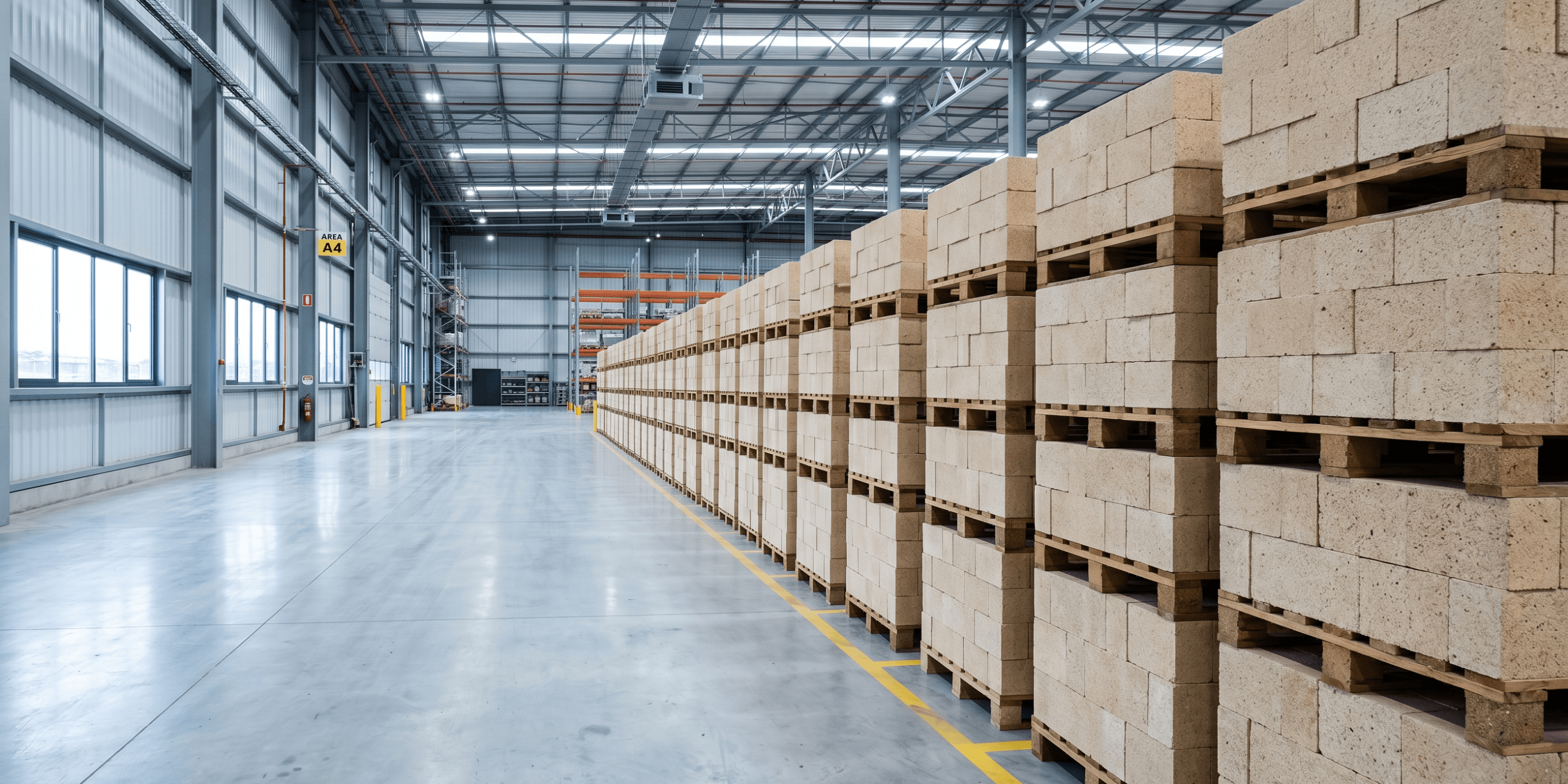
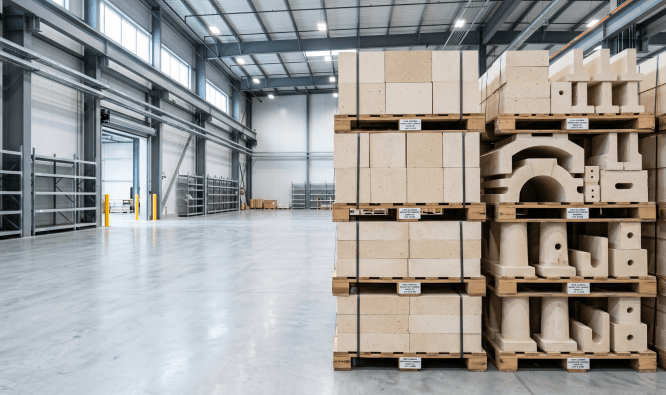
This project involved dimensioning silica bricks for a glass melting furnace lining — a mix of crown bricks, sidewall courses, and regenerator checker blocks, all in the >93% SiO₂ grade. The volume was substantial: a full glass furnace relining consumes hundreds of tonnes of silica refractory, and the cutting scope covered a significant proportion of the total brick count. The production requirement was not exotic profile work — it was straight dimensioning to specification, consistently, across a large batch.
Silica brick has a deceptive appearance — it looks solid and dense, and in terms of bulk strength it is. But under the point-contact and intermittent-force loading of a disc saw, the edges and faces chip in ways that are not obvious at first glance. The micro-fractures that appear at cut faces are not just cosmetic. In a glass furnace crown, where the hot face is under sustained thermal load with no opportunity for inspection or repair during the campaign, a cut face with subsurface damage is a pre-existing crack waiting to propagate. The cutting method has to produce faces that are genuinely clean, not just visually acceptable.
A glass furnace lining is assembled from bricks that are nominally identical in each course. Dimensional variation between bricks in the same course creates uneven joint widths — which in a silica crown at operating temperature translates to differential thermal expansion at the joints, stress concentration, and the onset of structural movement that shortens campaign life. The tolerance requirement for this project was ±1mm on all cut dimensions. Holding that tolerance across several hundred bricks requires a cutting setup that is stable over a long run, not one that requires frequent recalibration or that drifts progressively through the batch.
Glass furnace relines are scheduled events. The furnace comes down, the old lining is stripped, and the new lining has to be ready and on site within a defined window. The silica brick cutting scope was on the critical path for lining material availability — slow cutting throughput was not an option. The production method had to achieve the required volume within the available time, without sacrificing dimensional accuracy or edge quality to get there.
The choice between wire saw and bridge saw for a refractory cutting scope is not about one being better than the other in general — it is about matching the tool to the requirement. This scope was straight dimensioning in high volume. The CNC wire saw's advantage is path flexibility for complex profiles; for straight cuts in volume, the bridge saw is the appropriate platform.
Blade selection for silica required attention. Standard stone-cutting blades are not optimised for the fracture characteristics of high-silica refractory. The diamond specification, grit size, bond hardness, and blade geometry were selected for the material — specifically to minimise the impact and vibration loading at the cut face that drives micro-fracture in brittle silica. The result was a cut face that showed the clean, controlled surface associated with diamond cutting of brittle ceramics: no visible edge chipping, no gross surface cracking, and a face finish that was visually and dimensionally acceptable without secondary treatment.
Feed rate and depth of cut were also adjusted for silica. Silica cuts differently from high-alumina or magnesia: it is harder in one sense and more fracture-prone in another, and the relationship between cutting speed and surface damage is not the same as for denser, tougher refractories. Getting this right required some test cuts at the start of the production run to establish the parameter combination that gave acceptable face quality at the required throughput rate. Once established, the parameters were held constant through the batch.
The batch ran to completion within the required timeframe. A few points on the outcome:
Surface quality on the silica was consistently better than what abrasive disc cutting on this material typically produces. The edge condition on crown bricks — where the hot-face edge is the most critical — was clean across the batch. Whether this translates to measurably longer campaign life for the individual bricks is something only long-term service data would confirm, but the absence of visible subsurface damage at the cut faces is the starting point for that outcome.
Dimensional consistency stayed within the ±1mm requirement across the full batch. The blade specification and parameter settings that were established in the initial test cuts held stable through the run without requiring adjustment. In a long batch of a single material and format, this is what a correctly set up cutting process should do — it is worth saying explicitly because it is not always what happens when cut parameters have not been properly qualified for the material.
The only production variable that required active management was blade wear. Silica is abrasive to diamond in a specific way — the SiO₂ matrix breaks down diamond bond progressively, and the cut quality at end-of-blade-life is meaningfully different from the quality at the start. We tracked blade performance through the run and replaced at the point where surface quality began to degrade rather than running blades to failure. That is straightforward to manage but requires monitoring.
Silica refractory cutting is not a standard service — most stone and ceramic cutting operations do not have the blade specifications or the process experience to handle >93% SiO₂ material without producing the edge damage that makes the output unacceptable for glass furnace applications. Getting it right requires both the right tooling and an understanding of how silica responds to cutting force.
We do not publish client or project details as a matter of standard practice. What we can offer is a discussion of your specific brick formats, SiO₂ grade, dimensional requirements, and production volume — and an honest assessment of whether our process can meet your specification within your timeframe.
Dinosaw Machinery handles refractory cutting across both wire saw and bridge saw platforms, with process parameters developed for the specific material rather than carried over from stone or industrial ceramic cutting. If you are sourcing precision-dimensioned silica refractories for a glass furnace project, contact us with your brick specification.
 English
Get A Easy Solution
Chat Online
Hi, this is Lizzy from Dinosaw ( Not a Robot ). Which Machine ( model ) do you want? Please WhatsApp us now
Hello 👋 How can we help?