



 中文
中文 한국어
한국어


Ms.Lizzy
Hi, this is Lizzy from Dinosaw ( Not a Robot ). Which Machine ( model ) do you want? Please WhatsApp us now


Open Hours:8:30am-20:30pm

WhatsApp: +86 198-5901-3937

 Apr 2, 20265 MIN READ
 Apr 2, 20265 MIN READ
How CNC diamond wire saw profiling was applied to high-alumina brick shaping for rotary kiln transition zone linings — curved profiles, tight dimensional tolerances, no edge chipping on sintered ceramic.
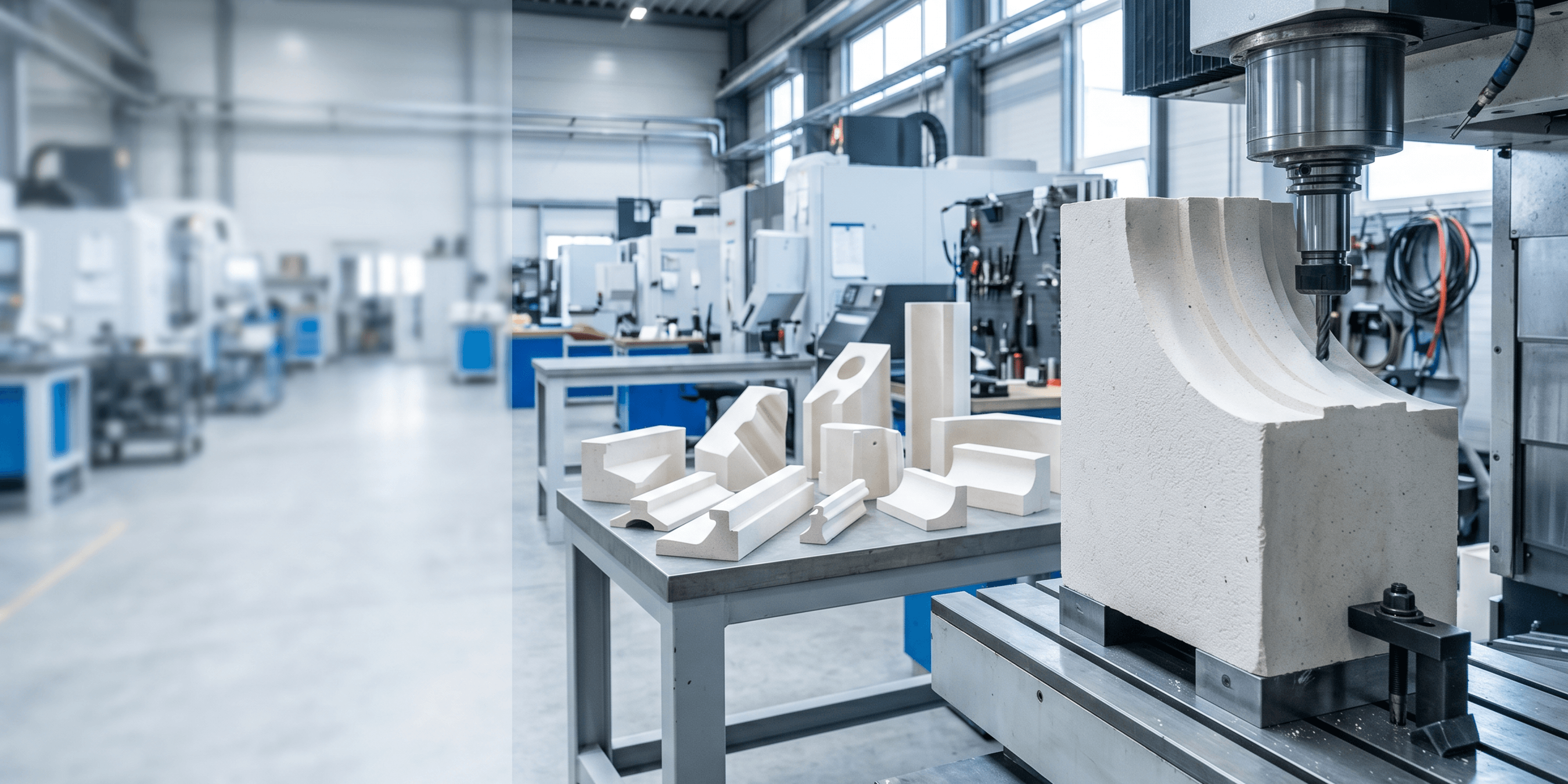
This project involved the production of high-alumina transition zone bricks for a cement rotary kiln relining. The material was a high-alumina grade with Al₂O₃ content above 70% — dense, hard, and characteristically brittle after firing. The profile requirements came directly from the kiln geometry drawings: tapered faces at defined angles, curved surfaces to match the shell radius at the installation zone, and dimensional tolerances tight enough that each piece would contribute to a self-supporting lining arch under operating load.
The transition zone brick profiles specified for this project included wedge tapers on two faces, a curved surface on the hot face, and angular cuts at the head ends. None of these could be produced by straight cutting in a single setup. A bridge saw approach would have required multiple setups per brick, manual repositioning between cuts, and angular jig work that introduces its own tolerance error. For a batch production run, this was not viable — each additional setup multiplied the error accumulation and the labour time per piece.
High-alumina brick at the >70% Al₂O₃ grade is microstructurally dense but has low fracture toughness — it does not yield before it breaks. The tapered edges and angular intersections on a transition zone brick profile are the points most vulnerable to chipping under cutting force. A chipped taper edge means the brick will not close correctly in the lining arch. In kiln lining work, a piece that does not close correctly is a rejected piece — the angular geometry is too specific to recover by secondary grinding without introducing new dimensional errors.
Transition zone lining installation works on the principle that all bricks in a ring are identical. If the tapers vary between pieces, the ring will not close uniformly, and the lining will have stress concentrations that accelerate wear at those points. The dimensional requirement was not just that each piece met the drawing — it was that every piece in the batch met the drawing to the same tolerance. That requires a cutting method that does not drift over a production run and does not require continuous manual compensation to stay on specification.
Diamond wire saw cutting is not the obvious first choice for refractory production — most refractory manufacturers think of wire saws in the context of large stone blocks or semiconductor wafers. The reason it is the right method here comes down to two things: the nature of the cutting force, and the availability of CNC path control.
Wire cutting applies a distributed abrasive force along the contact length between wire and material. There is no concentrated point load, no impact, and no blade-to-edge interaction that would cause the edge fracture typical of disc-abrasive methods on sintered ceramic. The wire abrades progressively. On a high-alumina brick, this means the tapered edges and angular intersections on the profile come out intact — the brittle fracture mode that would destroy these features under a disc saw does not engage.
CNC path control means the wire follows the profile geometry defined in the program. Curved faces, compound tapers, angular head cuts — each is a path the CNC executes, not a manual setup. Once the program is set for the profile, every piece in the batch runs through the same path. Dimensional drift between pieces comes from wire wear over the run and from material density variation in the bricks — both are manageable by monitoring and parameter adjustment rather than piece-by-piece manual correction.
The practical consequence for this project: the transition zone brick profiles were produced as programmed, with edge integrity maintained across the full profile geometry, and dimensional consistency held across the batch.
A few specifics worth noting from the production run:
Profile geometry held. The curved faces, tapers, and angular head cuts all came out to drawing. No secondary grinding was required to bring pieces onto specification — they came off the wire saw ready for dimensional check and dispatch.
Edge condition was acceptable across the batch. The corners and tapered intersections that had been identified as the most vulnerable points in the profile did not show the chipping that would have been expected from disc-abrasive methods on this material. The distributed cutting action of the wire kept these features intact.
Batch consistency was within the tolerance band required for lining ring assembly. Piece-to-piece variation was low enough that the transition zone bricks could be installed without sorting or selective assembly — the expected pattern for a production run where each ring position is interchangeable.
One thing worth being direct about: the CNC programming step for a complex profile is not trivial. Setting up the path for a new brick geometry, verifying it on the first piece, and adjusting for material response takes time at the start of a production run. For a repeat order on an established profile, this is a one-time cost. For a first-time profile from a new kiln geometry, it should be budgeted as part of the setup.
Every kiln is different. Transition zone geometry is specific to the kiln design, the shell diameter at each zone boundary, and the lining thickness and material selection for that installation. There is no standard profile that applies across kilns — each set of transition zone bricks is produced against a specific drawing or geometry file.
What we can offer is the capability to translate that geometry into a CNC cutting program and run it on high-alumina material without the edge damage or tolerance drift that alternative methods introduce. The setup work for a new profile is project-specific; the cutting process, once set up, is repeatable.
We do not publish case-specific details — client, kiln operator, installation site — as a matter of standard practice. If you are sourcing transition zone bricks or other profiled refractory shapes and want to discuss whether CNC wire saw cutting is the right approach for your geometry, Dinosaw Machinery is the conversation to have.
Contact us with your profile geometry or drawing.
 English
Get A Easy Solution
Chat Online
Hi, this is Lizzy from Dinosaw ( Not a Robot ). Which Machine ( model ) do you want? Please WhatsApp us now
Hello 👋 How can we help?