Diamond wire saw cutting applied to volume reduction of irradiated graphite moderator blocks in nuclear decommissioning — controlled dust, no thermal input, sealed particulate collection throughout.
Irradiated Graphite: A Decommissioning Waste Stream Unlike Most Others
Graphite moderator blocks from gas-cooled reactors present a decommissioning challenge that is qualitatively different from cutting concrete or steel. The material is brittle and friable — it generates dust under any cutting method. In its irradiated state, that dust carries the radioactivity of the parent material, including long-lived isotopes such as Carbon-14 and Chlorine-36. Fine graphite particles are light, they settle slowly, and they travel. Uncontrolled airborne graphite dust in a nuclear environment is not a nuisance — it is an internal contamination hazard of a type that is difficult to remediate once dispersed.
There is also the Wigner energy consideration. Irradiated graphite stores energy in its crystal lattice as a result of neutron bombardment. That energy can be released as heat if the graphite is subjected to thermal stimulus. Cutting methods that introduce significant heat to graphite are therefore excluded not just on contamination grounds, but on the basis of the physics of what the material is. Mechanical cutting at low thermal loading is the only sensible approach.
This project involved the volume reduction of irradiated graphite moderator blocks as part of a reactor decommissioning programme. The blocks needed to be reduced to dimensions compatible with the waste containers and disposal pathway applicable to their classification.
The Technical Constraints That Shaped the Cutting Approach
Cutting irradiated graphite without creating an airborne contamination event is the central technical challenge. Everything else — dimensional control, throughput, equipment configuration — is secondary to that.
Dust Containment from the First Cut to the Last
Unlike metal or concrete, where the primary contamination risk from cutting is at the cut surface, graphite produces dust throughout the cutting stroke — initiation, steady state, and completion. The extraction system cannot be tuned for average conditions; it has to capture effectively at the transient peaks as well. This is not a theoretical requirement. An extraction system that is adequate at steady state but falls behind during the cut initiation phase will allow dust to escape into the work area atmosphere at the most unpredictable moments.
Wigner Energy: Why Thermal Cutting Was Never on the Table
Wigner energy is stored in the graphite lattice as displaced carbon atoms that have been knocked out of their equilibrium positions by neutron bombardment. When the graphite is heated — even moderately — these atoms relax back, releasing energy as heat. In a large mass of irradiated graphite, this can become self-sustaining. Thermal cutting methods, which by definition introduce heat at the cut interface, are excluded from irradiated graphite work not because of regulatory preference but because of what the material will do if heated. This is not negotiable.
Fracture Behaviour: Controlled Cutting in a Brittle Material
Graphite does not yield under load the way metal does. It fractures. Cutting methods that apply concentrated point loads or impact forces risk producing uncontrolled fracture events — which generate burst particulate release and produce waste pieces of unpredictable geometry. Continuous, distributed cutting force is required. The cutting method has to work with the material's fracture behaviour, not against it.
Dimensional Output: Blocks Cut to Waste Container Specifications
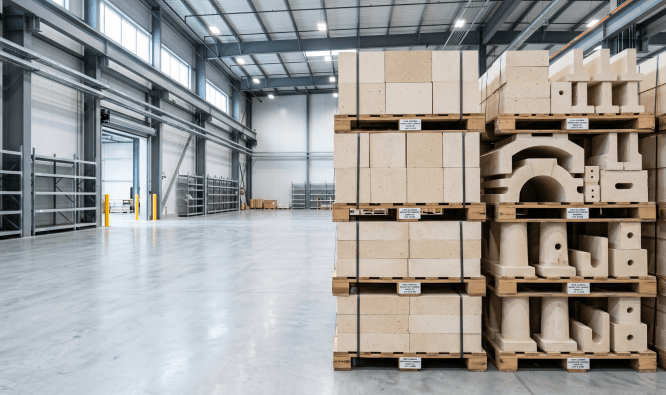
Volume reduction is not an end in itself — the cut pieces have to fit into the waste containers applicable to the graphite's classification. The target dimensions were determined by the container specification, not by what was easy to cut. The cutting approach needed to produce consistent dimensional output against a defined set of target geometries, across a range of block sizes.
Diamond Wire Cutting of Graphite: Parameters, Dust Extraction, and What We Adjusted
Diamond wire saw cutting suited the constraints here in a way that most other mechanical methods did not. The wire applies a continuous, distributed cutting force along its contact length with the graphite — exactly the loading characteristic that brittle materials tolerate without fracture. The cut is smooth and progressive, not percussive.
The absence of thermal input at the cut face directly addressed the Wigner energy constraint. Wire cutting generates friction heat, but at the levels relevant to graphite under controlled feed conditions, there is no measurable thermal stimulus at the cut surface. We verified this before committing to production cutting. No thermal events occurred during the cutting operations.
Wire parameters were adjusted specifically for graphite. Tension, feed rate, and wire speed were set to favour controlled material removal over cutting throughput — producing a finer, more uniform particulate than aggressive settings would generate. Finer particulate is captured more effectively by the extraction system. That was the trade-off we made deliberately.
The dust extraction system was run at elevated flow rate throughout each cut, matched to the particulate generation rate of graphite at our chosen operating parameters. The system was tested before production cutting began to verify that extraction capacity was sufficient at transient peaks — cut initiation, directional changes, and completion — not just at steady state. Where it was not, we adjusted before proceeding. This is the part of the work that does not show up in a cut completion report but matters considerably more than the cutting rate.
What the Volume Reduction Programme Delivered
Volume reduction operations were completed across the block inventory within the programme scope. The outcomes against the key programme objectives:
Dust containment held throughout. Airborne contamination monitoring during cutting operations did not record events attributable to graphite particulate from the cutting work. The extraction approach — elevated flow rate, verified at transient conditions before production — was effective.
No Wigner energy events. Wire cutting introduced no measurable thermal stimulus to the graphite. The concern that had prompted the exclusion of thermal methods did not materialise under mechanical cutting conditions.
Blocks were cut to target container dimensions. Pieces transferred directly to waste containers without secondary trimming. The combination of dimensional control and predictable cut geometry meant waste classification and consignment could proceed without additional handling steps.
One thing worth noting: the graphite dust generated during cutting, once captured and sealed, was classified and consigned from the collection containers directly. The extraction system effectively converted an airborne contamination risk into a manageable solid waste stream. That is what effective dust containment actually means in practice — not zero dust generation, but complete capture of what is generated.
Graphite Decommissioning Is a Specialist Area — What That Means for Equipment Selection
Graphite moderator decommissioning is not a large-volume market, and the number of organisations with direct cutting experience in irradiated reactor graphite is limited. That means equipment selection decisions are often made with less reference data than project teams would like — and with more reliance on the equipment supplier's understanding of the material than would be the case for a more commoditised application.
The constraints we described above — Wigner energy sensitivity, fine dust generation, fracture behaviour — are not abstract. They have practical consequences for how a cutting system has to be set up, tested, and operated. An approach that has not been validated against these characteristics before production cutting begins is a programme risk.
We treat each graphite project as a configuration exercise, not a product deployment. The cutting parameters, dust extraction capacity, and operational procedures are developed for the specific characteristics of the graphite being cut and the waste management requirements of the programme. Project details are kept confidential.
If you are working on a programme involving graphite moderator volume reduction, we are interested in the conversation at the earliest possible stage. Dinosaw Machinery provides diamond wire saw cutting solutions for irradiated graphite decommissioning, configured to the material characteristics and programme requirements of each project.
Contact us to discuss your graphite cutting scope.



 中文
中文 한국어
한국어


 Apr 10, 20265 MIN READ
 English