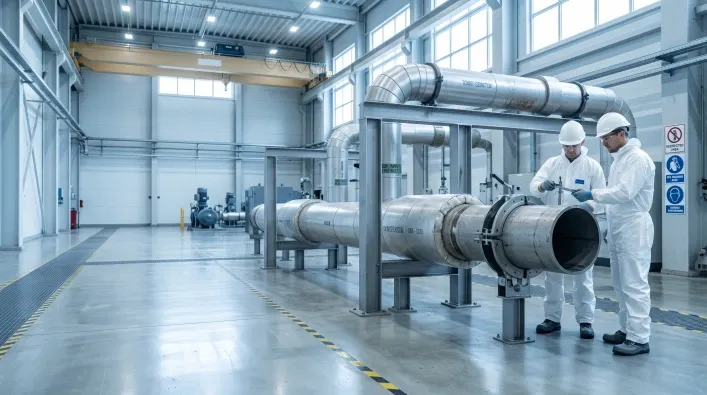
Mechanical diamond wire cutting applied to stainless and structural steel size reduction in a nuclear facility — no thermal input, no fumes from contaminated surfaces, controlled particulate throughout.
The Steel Cutting Problem in Nuclear Decommissioning
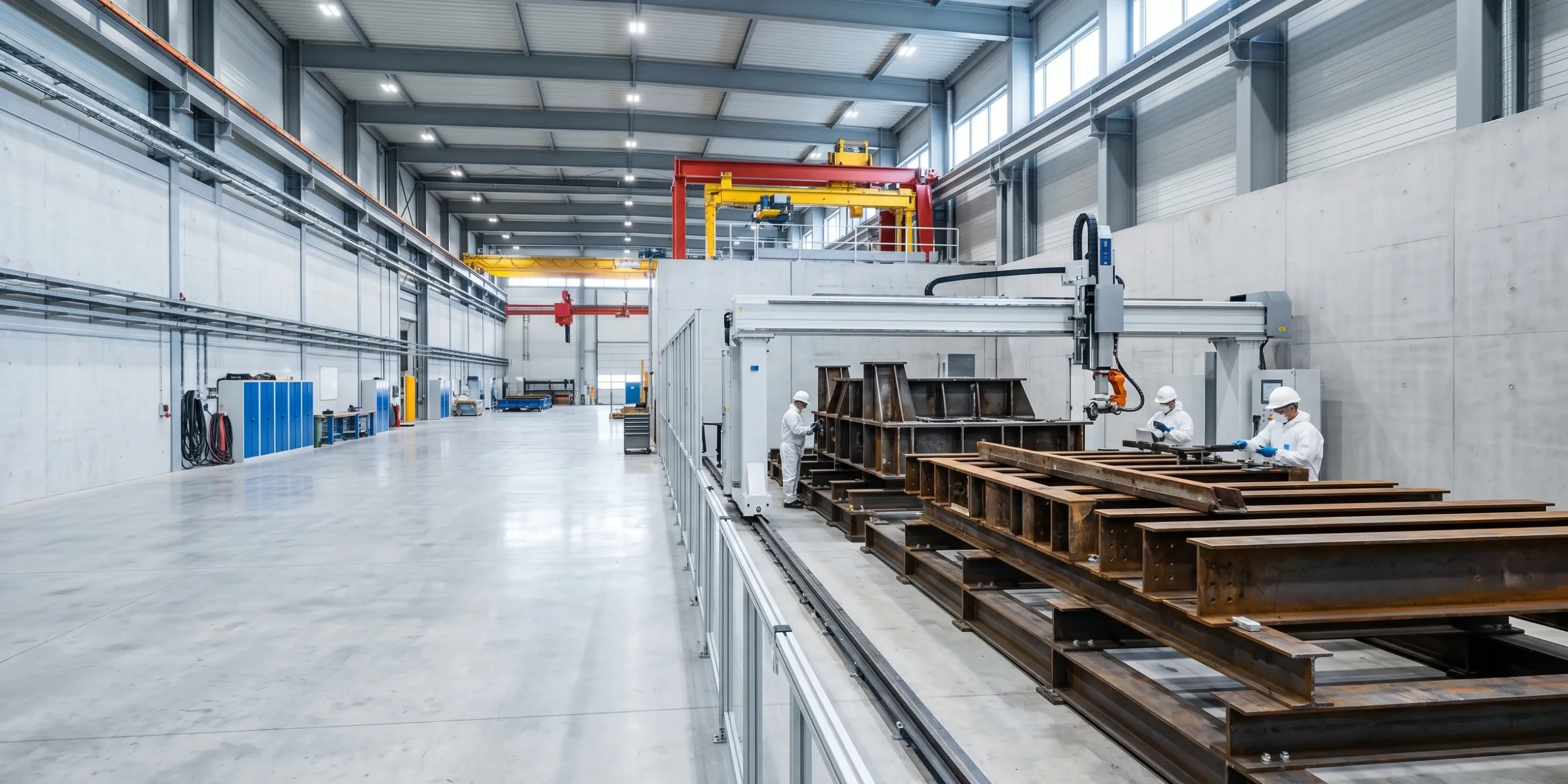
Stainless steel is everywhere in a nuclear facility — primary circuit pipework, pressure boundary components, vessel liners, structural members, contaminated ancillary equipment. When dismantlement begins, size reduction of these components is a routine requirement. The challenge is not the cutting itself; it is how you cut when the material is contaminated and the environment restricts what you can introduce to the work area.
Thermal cutting methods — plasma arc, oxy-fuel — are the standard industrial approach to steel. In most environments, they are fast and cost-effective. In a nuclear facility, they create a specific problem: heat at the cut surface volatilises contamination, generating fumes that carry activated or contaminated material into the atmosphere of the work area. Managing that airborne contamination is technically demanding and operationally expensive. The alternative is mechanical cutting, which avoids the problem by generating no heat at the cut interface.
This project involved the size reduction of austenitic stainless steel and structural steel components at a nuclear facility. Thermal cutting had been excluded from the scope on contamination control grounds.
What Made This Scope Harder Than Standard Industrial Steel Cutting
The constraints here were not primarily about cutting difficulty. They were about what the cutting method could not do.
No Aerosol Generation from Contaminated Steel Surfaces
The exclusion of thermal cutting was not a preference — it was a site requirement. Heat generated at a contaminated cut surface does not stay at the cut. It drives volatile species and fine particles into the atmosphere of the work area, creating an internal contamination hazard that is difficult to bound and expensive to remediate. Mechanical cutting keeps contamination where it started: at the cut location, in solid form, capturable by the extraction system.
Waste Classification: Keeping Contamination Boundaries Intact
The components being size-reduced had a defined contamination status. The cutting process was required not to redistribute contamination — through fume, spatter, or aerosol — beyond the immediate work zone. That meant clean cut faces, controlled swarf, and no secondary spread. Any method that could not guarantee this was off the table, regardless of cutting speed.
Variable Cross-Sections: Tubes, Flat Sections, and Compound Assemblies
The component mix was not uniform. Tubular sections, flat structural members, and irregular compound assemblies were all in scope. A method that worked well for one geometry but required significant re-engineering for another would have driven up the time — and therefore the dose — associated with the cutting phase. We needed an approach that could handle the range without constant re-setup.
Dimensional Accuracy: Cuts Had to Fit Waste Packaging First Time
Size reduction for waste packaging is not rough work. Cut dimensions determine whether a component fits within the container specifications applicable to its classification. Over-length pieces require secondary trimming — another operation in the controlled area, another dose contribution. The first cut needed to be right.
Why Diamond Wire Cutting Was the Right Mechanical Method
Several mechanical cutting methods can handle stainless steel. The reasons diamond wire saw cutting was selected for this scope came down to three things.
First, the absence of thermal effect at the cut face. The wire cuts by abrasion — removing material through mechanical contact, not melting. There is no heat-affected zone, no fume generation, no aerosol from the cut surface. For a scope where aerosol generation from contaminated material was the primary exclusion criterion, this was the defining characteristic.
Second, geometry adaptability. The wire can be routed around complex cross-sections, cutting tubular components in a single pass and flat sections by programming the cut geometry through CNC. The same system that handled round tube sections handled flat structural members and irregular assemblies — different wire routing, same equipment. That kept re-setup time, and therefore controlled-area time, to a minimum.
Third, cut quality. The diamond wire produces clean, burr-minimal cut faces with consistent dimensional output. Components cut to specification went directly to waste packaging without secondary dressing. In a programme where every additional handling step has a dose cost, that matters.
How the Cutting Operations Ran and What They Delivered
The full component mix — tubular, flat-section, and irregular assemblies — was processed through the diamond wire saw without re-engineering between component types. Wire routing was adjusted for geometry; everything else stayed the same.
No thermal cutting was introduced at any point. Airborne contamination monitoring during cutting operations did not record incidents attributable to the cutting work. The contamination control objective — keeping any redistribution of contaminated material within the immediate work zone — was met throughout.
Particulate from the cutting operations was captured by the integrated extraction system and collected in sealed containers. Classification and consignment proceeded directly from the collection units.
A practical benefit that is easy to overlook: no hot-work permits were required. In nuclear facility environments, the authorisation process for hot work can impose real scheduling constraints. Mechanical cutting removed that constraint entirely.
Components were cut to dimensions compatible with waste packaging specifications on the first cut. No secondary trimming was required across the scope.
Confidentiality and Next Steps
As with all nuclear decommissioning work we are involved in, the specific details of this project — client, site, programme parameters — are treated as confidential. What we have described here is the technical scope and the approach taken.
If you have steel components in a nuclear decommissioning or facility modification scope where thermal cutting has been excluded or is problematic, this is the kind of work we do. Dinosaw Machinery provides mechanical diamond wire saw solutions for steel component size reduction in radiologically controlled environments, configured to the geometry and waste management requirements of each project.
Contact us to discuss your cutting scope.



 中文
中文 한국어
한국어


 Apr 1, 20265 MIN READ
 English